Zaia Law Scales Across Multiple Countries with LegalBridge
Zaia Law Scales Across Multiple Countries with LegalBridge
Zaia Law
18th May 2026
Results at a Glance
Firm Profile
Attorney: Guilherme Castilho Zaia, Esq.
Firm: Zaia Law LLC
Locations: North Bethesda, Maryland (headquarters) and Florianópolis, Brazil (operations) Languages: Portuguese, Spanish, and English
Rating: 5.0 stars across 75+ Google reviews
Practice Areas
Employment-based immigration: EB-1A (Extraordinary Ability), EB-1B (Outstanding Researchers), EB-2 NIW (National Interest Waiver), O-1 (Extraordinary Ability), H-1B (Specialty Occupation), L-1 (Intracompany Transfer), E-2 (Treaty Investor), P-1 (Athletes and Entertainers)
Family-based immigration: K-1 fiancé(e) visas, marriage-based green cards (I-130 and I-485), immediate relative and preference categories (F1 through F4), consular processing, and waivers
Special Immigrant Juvenile Status (SIJS): For vulnerable minors with state court predicate orders
Naturalization and citizenship: N-400 applications, derivative citizenship analysis, and N-600 certificates
Attorney: Guilherme Castilho Zaia, Esq.
Firm: Zaia Law LLC
Locations: North Bethesda, Maryland (headquarters) and Florianópolis, Brazil (operations) Languages: Portuguese, Spanish, and English
Rating: 5.0 stars across 75+ Google reviews
Practice Areas
Employment-based immigration: EB-1A (Extraordinary Ability), EB-1B (Outstanding Researchers), EB-2 NIW (National Interest Waiver), O-1 (Extraordinary Ability), H-1B (Specialty Occupation), L-1 (Intracompany Transfer), E-2 (Treaty Investor), P-1 (Athletes and Entertainers)
Family-based immigration: K-1 fiancé(e) visas, marriage-based green cards (I-130 and I-485), immediate relative and preference categories (F1 through F4), consular processing, and waivers
Special Immigrant Juvenile Status (SIJS): For vulnerable minors with state court predicate orders
Naturalization and citizenship: N-400 applications, derivative citizenship analysis, and N-600 certificates
The Challenge: Two Offices, Ten Visa Types, One Overflowing Inbox
Guilherme Zaia built his practice on a simple promise: give extraordinary foreign professionals, binational families, and survivors a trusted path to the United States. Word traveled fast through Brazilian professional networks, expat communities, and word-of-mouth referrals. Within two years, the firm was simultaneously handling sophisticated EB-1A petitions for principal investigators, EB-2 NIW filings for physicians and STEM professionals, O-1 cases for athletes and creatives, marriage-based green cards for binational couples, SIJS cases for unaccompanied minors, U-visa applications for survivors of violent crime, and naturalization filings, often all within the same week.
The growth was gratifying. The operations were not.
"I was managing cases from multiple countries across more than ten visa categories, and my system was basically WhatsApp and Google Drive. A client in Brazil would send documents at 11 PM their time. My paralegal in Maryland would wake up to 40 unread messages, three new WhatsApp threads, and a Google Drive folder named 'docs final FINAL v3.' We had no single place to see what was submitted, what was missing, and what was overdue."
Each visa type carried its own evidentiary standards, procedural quirks, and strategic considerations.
An EB-2 NIW required a detailed legal memorandum applying the Matter of Dhanasar framework, evidence of substantial merit and national importance, and a persuasive argument that the petitioner was well positioned to advance the proposed endeavor. An EB-1A required documentation across at least three of the regulatory criteria plus a defensible final merits determination. An O-1 needed comparable evidence of extraordinary ability or achievement, often coordinated across booking agents, employers, and international references. A SIJS case required state court predicate orders, school records, and careful documentation of abuse, neglect, or abandonment. A marriage-based I-130 needed extensive proof of a bona fide relationship. A U-visa required a certified Form I-918B from a qualifying law enforcement agency, a detailed personal declaration, and waiver analysis. An asylum case required country conditions research, sworn declarations, and consistency across years of testimony.
The firm knew how to win all of these cases. Tracking them was chaos.
"I would start preparing an I-485 and realize halfway through that we never received the client's birth certificate. Or I would find three files named 'passport.pdf' from different family members with no way to tell them apart. Spouses' names had different spellings on different documents because nobody noticed until USCIS did. We were spending more time organizing than lawyering."
The breaking point came when a SIJS deadline nearly slipped because a required signature sat unanswered in an email thread for two weeks. Another near-miss involved a misrepresentation case where critical FOIA records arrived just before an I-485 interview, but the file structure made it nearly impossible to integrate them into the response brief on time.
Guilherme knew he needed a real system. Not more spreadsheets. Not more WhatsApp groups. Not another shared folder titled "FINAL_v4_use_this_one."
Guilherme Zaia built his practice on a simple promise: give extraordinary foreign professionals, binational families, and survivors a trusted path to the United States. Word traveled fast through Brazilian professional networks, expat communities, and word-of-mouth referrals. Within two years, the firm was simultaneously handling sophisticated EB-1A petitions for principal investigators, EB-2 NIW filings for physicians and STEM professionals, O-1 cases for athletes and creatives, marriage-based green cards for binational couples, SIJS cases for unaccompanied minors, U-visa applications for survivors of violent crime, and naturalization filings, often all within the same week.
The growth was gratifying. The operations were not.
"I was managing cases from multiple countries across more than ten visa categories, and my system was basically WhatsApp and Google Drive. A client in Brazil would send documents at 11 PM their time. My paralegal in Maryland would wake up to 40 unread messages, three new WhatsApp threads, and a Google Drive folder named 'docs final FINAL v3.' We had no single place to see what was submitted, what was missing, and what was overdue."
Each visa type carried its own evidentiary standards, procedural quirks, and strategic considerations.
An EB-2 NIW required a detailed legal memorandum applying the Matter of Dhanasar framework, evidence of substantial merit and national importance, and a persuasive argument that the petitioner was well positioned to advance the proposed endeavor. An EB-1A required documentation across at least three of the regulatory criteria plus a defensible final merits determination. An O-1 needed comparable evidence of extraordinary ability or achievement, often coordinated across booking agents, employers, and international references. A SIJS case required state court predicate orders, school records, and careful documentation of abuse, neglect, or abandonment. A marriage-based I-130 needed extensive proof of a bona fide relationship. A U-visa required a certified Form I-918B from a qualifying law enforcement agency, a detailed personal declaration, and waiver analysis. An asylum case required country conditions research, sworn declarations, and consistency across years of testimony.
The firm knew how to win all of these cases. Tracking them was chaos.
"I would start preparing an I-485 and realize halfway through that we never received the client's birth certificate. Or I would find three files named 'passport.pdf' from different family members with no way to tell them apart. Spouses' names had different spellings on different documents because nobody noticed until USCIS did. We were spending more time organizing than lawyering."
The breaking point came when a SIJS deadline nearly slipped because a required signature sat unanswered in an email thread for two weeks. Another near-miss involved a misrepresentation case where critical FOIA records arrived just before an I-485 interview, but the file structure made it nearly impossible to integrate them into the response brief on time.
Guilherme knew he needed a real system. Not more spreadsheets. Not more WhatsApp groups. Not another shared folder titled "FINAL_v4_use_this_one."
The Solution: One Platform for Every Case Type
Guilherme implemented LegalBridge as the firm's operating system. Every case, regardless of visa category, now follows a structured workflow from intake through approval and post-approval compliance.
Standardized Workflows for Every Visa Type
When Zaia Law opens a new case, the system automatically generates the complete workflow tailored to that case type, with milestones, document checklists, and deadline tracking already in place.
EB-2 NIW cases follow a proven sequence: intake and credential evaluation, evidence collection mapped to each Dhanasar prong, recommendation letter coordination with independent experts, business plan or implementation plan development where applicable, I-140 preparation, legal memorandum drafting, exhibit assembly with proper tabbing, signature collection, and filing with USCIS.
EB-1A cases route through a parallel but distinct workflow that builds out the three of ten regulatory criteria, supporting documentation, comparable evidence analysis, and final merits arguments.
O-1 cases include itinerary coordination, sponsor or agent letter drafting, consultation requests from peer organizations or labor unions where required, and evidence packaging that aligns with the eight regulatory criteria.
SIJS cases have their own workflow: state court predicate order coordination with state family or juvenile court counsel, school records, social history documentation, I-360 preparation, supporting brief, and adjustment of status when appropriate.
U-visa cases include law enforcement certification outreach, victim declaration development, supporting evidence collection, I-918 and I-918 Supplement B preparation, waiver analysis, and bona fide determination tracking.
Asylum and removal defense matters track court deadlines, country conditions research, expert declarations, and supporting briefs through every hearing phase.
No more reinventing the process for each case. No more wondering whether a recommendation letter has been requested or whether a state court order is still pending.
"The workflows are like having a senior associate looking over my shoulder for every case type. When a new paralegal joins my team, I do not have to verbally walk them through every step of an O-1 petition. The system shows them what to collect, when to collect it, and how it fits into the overall strategy. Onboarding time has dropped dramatically."
Guilherme implemented LegalBridge as the firm's operating system. Every case, regardless of visa category, now follows a structured workflow from intake through approval and post-approval compliance.
Standardized Workflows for Every Visa Type
When Zaia Law opens a new case, the system automatically generates the complete workflow tailored to that case type, with milestones, document checklists, and deadline tracking already in place.
EB-2 NIW cases follow a proven sequence: intake and credential evaluation, evidence collection mapped to each Dhanasar prong, recommendation letter coordination with independent experts, business plan or implementation plan development where applicable, I-140 preparation, legal memorandum drafting, exhibit assembly with proper tabbing, signature collection, and filing with USCIS.
EB-1A cases route through a parallel but distinct workflow that builds out the three of ten regulatory criteria, supporting documentation, comparable evidence analysis, and final merits arguments.
O-1 cases include itinerary coordination, sponsor or agent letter drafting, consultation requests from peer organizations or labor unions where required, and evidence packaging that aligns with the eight regulatory criteria.
SIJS cases have their own workflow: state court predicate order coordination with state family or juvenile court counsel, school records, social history documentation, I-360 preparation, supporting brief, and adjustment of status when appropriate.
U-visa cases include law enforcement certification outreach, victim declaration development, supporting evidence collection, I-918 and I-918 Supplement B preparation, waiver analysis, and bona fide determination tracking.
Asylum and removal defense matters track court deadlines, country conditions research, expert declarations, and supporting briefs through every hearing phase.
No more reinventing the process for each case. No more wondering whether a recommendation letter has been requested or whether a state court order is still pending.
"The workflows are like having a senior associate looking over my shoulder for every case type. When a new paralegal joins my team, I do not have to verbally walk them through every step of an O-1 petition. The system shows them what to collect, when to collect it, and how it fits into the overall strategy. Onboarding time has dropped dramatically."
A Client Portal That Eliminates the WhatsApp Chaos
Clients in Brazil, the United States, Portugal, and beyond now receive secure portal access with clear, visa-specific document checklists in their native language. They see exactly what is needed (passport biographical page, birth certificate, marriage certificate, country conditions evidence, employer support letters, tax transcripts) and upload directly to organized, properly labeled folders. The firm sees a dashboard showing received versus outstanding documents for every case, color-coded by priority and deadline.
"Clients used to ask 'did you get my passport?' five times by email and three times on WhatsApp. Now they log in and see a green checkmark. The peace of mind it gives them, especially for people who have waited years for this moment, is enormous. And my team is not digging through email threads to find attachments."
For Brazilian clients in particular, the multilingual interface has been transformative. A physician in Recife preparing an EB-2 NIW petition can navigate her checklist in Portuguese, upload her CRM registration, residency certificates, and publications, and receive automated reminders in her time zone. A tattoo artist in Florianópolis pursuing an O-1B can submit his portfolio, gallery contracts, and convention bookings without translating instructions every time.
Clients in Brazil, the United States, Portugal, and beyond now receive secure portal access with clear, visa-specific document checklists in their native language. They see exactly what is needed (passport biographical page, birth certificate, marriage certificate, country conditions evidence, employer support letters, tax transcripts) and upload directly to organized, properly labeled folders. The firm sees a dashboard showing received versus outstanding documents for every case, color-coded by priority and deadline.
"Clients used to ask 'did you get my passport?' five times by email and three times on WhatsApp. Now they log in and see a green checkmark. The peace of mind it gives them, especially for people who have waited years for this moment, is enormous. And my team is not digging through email threads to find attachments."
For Brazilian clients in particular, the multilingual interface has been transformative. A physician in Recife preparing an EB-2 NIW petition can navigate her checklist in Portuguese, upload her CRM registration, residency certificates, and publications, and receive automated reminders in her time zone. A tattoo artist in Florianópolis pursuing an O-1B can submit his portfolio, gallery contracts, and convention bookings without translating instructions every time.
Multilingual Intake Questionnaires
Portuguese-speaking clients complete intake questionnaires in their native language. Their responses automatically populate the relevant USCIS forms (I-130, I-485, I-140, I-360, I-765, I-131, I-918, I-918A, I-589, N-400), eliminating manual data entry and transcription errors. Names are spelled consistently across every form. Addresses match. Dates align. Prior immigration history flows correctly into every relevant question.
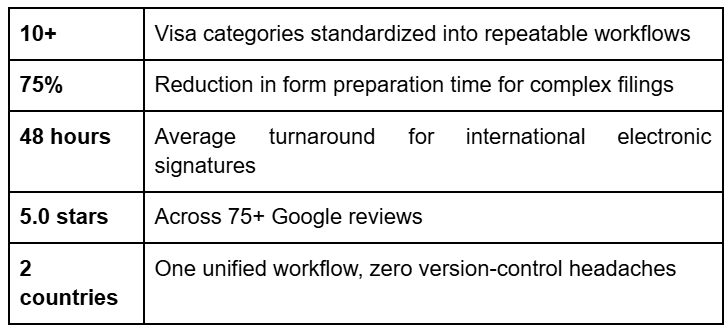
Form completion time decreased from approximately four hours to under one hour for complex filings like a full I-485 adjustment package. For a firm filing dozens of these per month, the time savings compound rapidly.
"The error rate on basic biographic data has dropped to near zero. Those errors used to generate RFEs, NOIDs, and worse. Now we catch issues at intake, not after USCIS catches them six months later."
Electronic Signatures That Cross Borders
Immigration petitions frequently require multiple signatures: the petitioner, the beneficiary, the employer or sponsor, the attorney, and sometimes interpreters or preparers. Collecting these across two countries, three time zones, and varying levels of technological comfort used to take weeks of email coordination, scanning, and re-scanning. Now the system identifies every signature field, automatically routes signature requests in the correct order, and tracks completion in real time.
"We had signatures stuck in email limbo for weeks. Now we get most signatures within 48 hours. For clients in Brazil, they sign from their phone at midnight. No printing, no scanning, no international FedEx, no notarization theater for forms that do not actually require notarization."
Portuguese-speaking clients complete intake questionnaires in their native language. Their responses automatically populate the relevant USCIS forms (I-130, I-485, I-140, I-360, I-765, I-131, I-918, I-918A, I-589, N-400), eliminating manual data entry and transcription errors. Names are spelled consistently across every form. Addresses match. Dates align. Prior immigration history flows correctly into every relevant question.
Form completion time decreased from approximately four hours to under one hour for complex filings like a full I-485 adjustment package. For a firm filing dozens of these per month, the time savings compound rapidly.
"The error rate on basic biographic data has dropped to near zero. Those errors used to generate RFEs, NOIDs, and worse. Now we catch issues at intake, not after USCIS catches them six months later."
Electronic Signatures That Cross Borders
Immigration petitions frequently require multiple signatures: the petitioner, the beneficiary, the employer or sponsor, the attorney, and sometimes interpreters or preparers. Collecting these across two countries, three time zones, and varying levels of technological comfort used to take weeks of email coordination, scanning, and re-scanning. Now the system identifies every signature field, automatically routes signature requests in the correct order, and tracks completion in real time.
"We had signatures stuck in email limbo for weeks. Now we get most signatures within 48 hours. For clients in Brazil, they sign from their phone at midnight. No printing, no scanning, no international FedEx, no notarization theater for forms that do not actually require notarization."
The Results: 200+ Cases Without the Chaos
Six months after implementing LegalBridge, Zaia Law operates at a scale that would have been impossible before, without adding headcount proportionally to case volume.
Case Volume. The firm now manages more than 200 active cases simultaneously across employment-based, family-based, humanitarian, removal defense, and citizenship categories. Every case has clear status visibility, deadline tracking, and a complete document inventory at any moment.
Preparation Time. Form completion dropped from four hours to under one hour for complex filings like I-485. Document collection that once required weeks of follow-up now happens in days through the client portal. RFE responses that used to involve hunting through folders are now assembled from a central, organized record.
Quality Consistency. Every EB-2 NIW case follows the same proven workflow grounded in Matter of Dhanasar. Every SIJS case includes the same required predicate elements. Every U-visa includes the certification, declaration, and waiver analysis. Junior team members produce senior-level work because the system enforces standards rather than relying on tribal knowledge.
Client Experience. The firm maintains a 5.0-star rating across more than 75 Google reviews. Clients consistently mention "clear communication," "always knew where we stood," "responsive in Portuguese and English," and "professional process." That language reflects organized operations as much as legal expertise.
Geographic Reach. The firm serves clients across the United States (Maryland, New Jersey, Pennsylvania, Florida, California, Texas, Massachusetts, Connecticut, and beyond) and internationally (Brazil, Portugal, Argentina, Mexico, and others). The unified platform eliminates the friction of cross-border practice that once defined the firm's daily operations.
Specialization Capacity. With operations streamlined, Guilherme has launched dedicated niche verticals:
Ink and Visa is a focused initiative for tattoo artists, illustrators, and visual creators pursuing O-1B and EB-1A pathways, with a distinct brand identity and content strategy designed for that creative community.
Foreign-trained healthcare professionals is an initiative focused on Florida-based placements (O-1, EB-2 NIW, and H-1B) for physicians, dentists, and allied health professionals seeking to credential and practice in the United States.
These verticals exist because the underlying operations no longer consume every available hour.
AI Eligibility: Turning Website Visitors into Qualified Leads
Embedding AI-powered eligibility evaluation on the firm's website helps prospects feel understood and valued from the first interaction. Rather than filling out a generic contact form and waiting days for a response, they receive immediate, substantive feedback on their visa eligibility, in their own language.
The AI evaluation walks prospects through a structured intake (education, work experience, achievements, publications, awards, family ties, country of origin, current status, and prior immigration history) and provides immediate feedback: qualification likelihood, potentially viable pathways, recommended next steps, and red flags worth discussing with counsel. Zaia Law automatically receives the prospect's information, including the AI's preliminary assessment, in the case management system, with the lead already partially qualified.
"Before, I would spend 30 minutes on consultation calls with people who did not qualify for anything I handle. Now the evaluation pre-screens them. When someone books a consultation, they already know their case strength, the relevant visa categories, and the general process. We talk strategy instead of explaining basic eligibility. It respects their time and mine."
The evaluation also captures prospects who are not yet ready. Early-career professionals receive guidance on strengthening their profiles (publishing, presenting, securing leadership roles, building a portfolio of measurable impact). When they become qualified candidates in a year or two, Zaia Law is already their trusted resource. The firm built a referral and education pipeline, not just a lead funnel.
This approach pairs naturally with the firm's robust educational content strategy. On Instagram, TikTok, and YouTube Shorts in Portuguese, Guilherme regularly explains EB-2 NIW eligibility, EB-1A criteria, O-1 standards, U-visa basics, and family-based pathways to a growing Brazilian audience. Education builds trust. The AI evaluation converts that trust into qualified inquiries. LegalBridge handles the rest.
What's Next
Guilherme's vision is to remain a boutique firm (high-touch service for a select number of clients) while serving more families and professionals than a traditional small practice could realistically handle. The firm is currently expanding its humanitarian practice, deepening its capacity in EB-1A and O-1 work for athletes, scientists, and artists, and developing additional industry-specific verticals.
"I did not become an immigration attorney to organize folders and chase signatures. I became one to help people build their lives in America. Some of them are world-class scientists. Some are tattoo artists. Some are survivors of violence. Some are children who came alone. They deserve a lawyer who is present, not a lawyer who is buried in administrative work. LegalBridge handles the complexity so I can focus on the work that actually requires a lawyer."
The client portal link sits prominently on Zaia Law's website, right next to Fale Conosco ("Talk to Us"). For a firm built on trust, multilingual service, and deeply personal advocacy, that visibility says everything: this is how we work now.
Six months after implementing LegalBridge, Zaia Law operates at a scale that would have been impossible before, without adding headcount proportionally to case volume.
Case Volume. The firm now manages more than 200 active cases simultaneously across employment-based, family-based, humanitarian, removal defense, and citizenship categories. Every case has clear status visibility, deadline tracking, and a complete document inventory at any moment.
Preparation Time. Form completion dropped from four hours to under one hour for complex filings like I-485. Document collection that once required weeks of follow-up now happens in days through the client portal. RFE responses that used to involve hunting through folders are now assembled from a central, organized record.
Quality Consistency. Every EB-2 NIW case follows the same proven workflow grounded in Matter of Dhanasar. Every SIJS case includes the same required predicate elements. Every U-visa includes the certification, declaration, and waiver analysis. Junior team members produce senior-level work because the system enforces standards rather than relying on tribal knowledge.
Client Experience. The firm maintains a 5.0-star rating across more than 75 Google reviews. Clients consistently mention "clear communication," "always knew where we stood," "responsive in Portuguese and English," and "professional process." That language reflects organized operations as much as legal expertise.
Geographic Reach. The firm serves clients across the United States (Maryland, New Jersey, Pennsylvania, Florida, California, Texas, Massachusetts, Connecticut, and beyond) and internationally (Brazil, Portugal, Argentina, Mexico, and others). The unified platform eliminates the friction of cross-border practice that once defined the firm's daily operations.
Specialization Capacity. With operations streamlined, Guilherme has launched dedicated niche verticals:
Ink and Visa is a focused initiative for tattoo artists, illustrators, and visual creators pursuing O-1B and EB-1A pathways, with a distinct brand identity and content strategy designed for that creative community.
Foreign-trained healthcare professionals is an initiative focused on Florida-based placements (O-1, EB-2 NIW, and H-1B) for physicians, dentists, and allied health professionals seeking to credential and practice in the United States.
These verticals exist because the underlying operations no longer consume every available hour.
AI Eligibility: Turning Website Visitors into Qualified Leads
Embedding AI-powered eligibility evaluation on the firm's website helps prospects feel understood and valued from the first interaction. Rather than filling out a generic contact form and waiting days for a response, they receive immediate, substantive feedback on their visa eligibility, in their own language.
The AI evaluation walks prospects through a structured intake (education, work experience, achievements, publications, awards, family ties, country of origin, current status, and prior immigration history) and provides immediate feedback: qualification likelihood, potentially viable pathways, recommended next steps, and red flags worth discussing with counsel. Zaia Law automatically receives the prospect's information, including the AI's preliminary assessment, in the case management system, with the lead already partially qualified.
"Before, I would spend 30 minutes on consultation calls with people who did not qualify for anything I handle. Now the evaluation pre-screens them. When someone books a consultation, they already know their case strength, the relevant visa categories, and the general process. We talk strategy instead of explaining basic eligibility. It respects their time and mine."
The evaluation also captures prospects who are not yet ready. Early-career professionals receive guidance on strengthening their profiles (publishing, presenting, securing leadership roles, building a portfolio of measurable impact). When they become qualified candidates in a year or two, Zaia Law is already their trusted resource. The firm built a referral and education pipeline, not just a lead funnel.
This approach pairs naturally with the firm's robust educational content strategy. On Instagram, TikTok, and YouTube Shorts in Portuguese, Guilherme regularly explains EB-2 NIW eligibility, EB-1A criteria, O-1 standards, U-visa basics, and family-based pathways to a growing Brazilian audience. Education builds trust. The AI evaluation converts that trust into qualified inquiries. LegalBridge handles the rest.
What's Next
Guilherme's vision is to remain a boutique firm (high-touch service for a select number of clients) while serving more families and professionals than a traditional small practice could realistically handle. The firm is currently expanding its humanitarian practice, deepening its capacity in EB-1A and O-1 work for athletes, scientists, and artists, and developing additional industry-specific verticals.
"I did not become an immigration attorney to organize folders and chase signatures. I became one to help people build their lives in America. Some of them are world-class scientists. Some are tattoo artists. Some are survivors of violence. Some are children who came alone. They deserve a lawyer who is present, not a lawyer who is buried in administrative work. LegalBridge handles the complexity so I can focus on the work that actually requires a lawyer."
The client portal link sits prominently on Zaia Law's website, right next to Fale Conosco ("Talk to Us"). For a firm built on trust, multilingual service, and deeply personal advocacy, that visibility says everything: this is how we work now.
Why LegalBridge Works for Multilingual Immigration Practices
LegalBridge serves immigration law firms, international clients, and multilingual operations. The platform standardizes workflows across case types, automates document collection through client portals, eliminates signature delays through cross-border electronic signing, and integrates AI-powered eligibility screening that qualifies leads before they reach the attorney's calendar.
Immigration attorneys using LegalBridge reduce case preparation time by 50 to 70 percent, scale capacity without proportional headcount growth, and maintain quality consistency across every visa category from EB-1A and EB-2 NIW to U-visa, asylum, and SIJS.
For practices serving immigrant communities, the multilingual capacity matters as much as the workflow automation. Clients want to be understood in their own language. Lawyers want their data clean, their deadlines tracked, and their workflows defensible. LegalBridge delivers both.
Ready to streamline your immigration practice? Visit legalbridge.ai to see how workflow automation can help you manage more cases with less chaos, in any language your clients speak.
LegalBridge serves immigration law firms, international clients, and multilingual operations. The platform standardizes workflows across case types, automates document collection through client portals, eliminates signature delays through cross-border electronic signing, and integrates AI-powered eligibility screening that qualifies leads before they reach the attorney's calendar.
Immigration attorneys using LegalBridge reduce case preparation time by 50 to 70 percent, scale capacity without proportional headcount growth, and maintain quality consistency across every visa category from EB-1A and EB-2 NIW to U-visa, asylum, and SIJS.
For practices serving immigrant communities, the multilingual capacity matters as much as the workflow automation. Clients want to be understood in their own language. Lawyers want their data clean, their deadlines tracked, and their workflows defensible. LegalBridge delivers both.
Ready to streamline your immigration practice? Visit legalbridge.ai to see how workflow automation can help you manage more cases with less chaos, in any language your clients speak.
Featured Interview


FAQs
We’ve Got the Answers You’re Looking For
We’ve Got the Answers You’re Looking For
Quick answers to your questions.
How does AI drafting learn my firm's writing style?
How much time does AI drafting actually save?
What's included in exhibit assembly automation?
What's the typical ROI timeline?
What security measures protect client information?
Can I use the platform for both USCIS filings and consular processing?
Does the platform work for international clients?
What visa categories does the platform support?
Does LegalBridge integrate with accounting or time tracking systems?
How do I create multiple applications for the same client (e.g., N-600K for each child)?
How does AI drafting learn my firm's writing style?
How much time does AI drafting actually save?
What's included in exhibit assembly automation?
What's the typical ROI timeline?
What security measures protect client information?
Can I use the platform for both USCIS filings and consular processing?
Does the platform work for international clients?
What visa categories does the platform support?
Does LegalBridge integrate with accounting or time tracking systems?
How do I create multiple applications for the same client (e.g., N-600K for each child)?