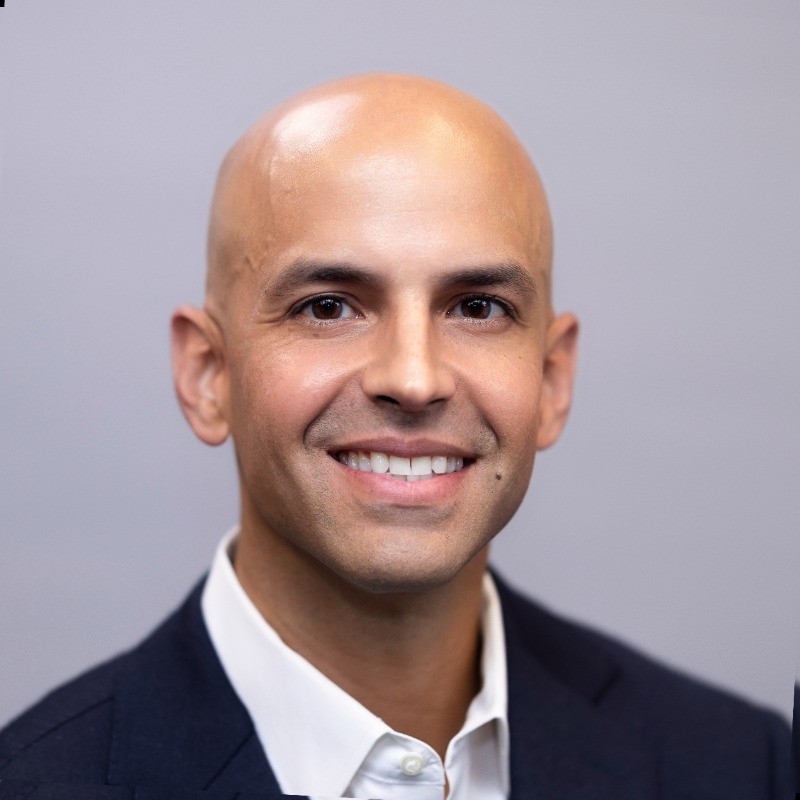

Louis Massard, a partner at Corporate Immigration Partners (CIP) and Envoy, has spent more than a decade guiding companies and their employees through the United States immigration system. In conversation with LegalBridge Magazine, he explains why the work has always been personal, why the grind matters, and why the loudest news rarely tells the whole story.
Picture a kid moving between worlds. A bilingual household. Summers spent abroad. A father who was French but built his entire life in Colombia, and a mother whose family was Colombian through and through. For Louis Massard, immigration was never a topic he discovered in a lecture hall.
"I was fascinated by the movement of people, money, goods across borders," he says, "how places could seem so different, but that there were core values that tied people together, regardless of where you go in the world."
That early fascination became a career. Today, Massard is a partner at Corporate Immigration Partners (CIP) and Envoy Global, where he has spent more than ten years helping corporations and their employees navigate one of the most unpredictable areas of American law. What sets his perspective apart is not a louder opinion on the news cycle. It is a more measured and balanced one.
A Family of Immigrants: Where Louis Massard's Career in Immigration Law Began
Massard is careful not to overstate the role his origin story had in his professional pursuits, but he does not pretend the connection is coincidental either. His family navigated its own immigration journeys, his parents first and, more recently, his sister. Watching those journeys up close gave him something most attorneys have to learn on the job: an instinct for what is actually at stake.
"It's a practice that is personal to me and personal to my background," he says. Straddling two cultures as a child taught him that borders are lines on a map, but the people crossing them are carrying families, aspirations, and entire futures.
That human thread runs through everything he says next.
From Trade Remedies to Immigration: Louis Massard's Path to Corporate Immigration Partners
Massard's route into immigration law was not a straight line. Before law school, he worked at the Department of State and later as a paralegal in Washington, D.C., in the world of international trade remedies, tariffs, duties, and countervailing measures against goods that U.S. industries considered unfairly traded.
It was steady, technical work. But it was the work he did on the side that pointed him toward his future. Because he spoke Spanish, he volunteered at naturalization clinics, walking applicants through the forms and the process. He did not leave law school certain that immigration would be his field. The pro bono work made the decision for him.
"We were always telling the story of people and of families and of their dreams," he says. People coming to the United States to reunite with a loved one, to pursue economic opportunity, to start a life. "I've always been attracted by that element of the work."
After law school, he spent his early years at a regional immigration firm in Charlotte, North Carolina. In early 2016, he joined CIP and Envoy as an associate attorney. He has been there ever since, and he has been a partner for years.
Louis Massard's Advice for Associate Attorneys Aiming for Partner
Ask Massard how a young attorney becomes a great one, and he offers no shortcut. He stresses the importance of time and reps.
"There's no shortcut to achieving that mastery other than just getting your reps in," he says. The early years can feel repetitive. They can feel like being buried under work. But that volume, he argues, is exactly what builds mastery and credibility in front of a client. The day you can say "I have seen a flavor of this before, five years ago," you have something no textbook can give you.
His advice to a brand-new associate is blunt and honest. "For a young attorney, it's really just about the grind, unfortunately, for lack of a better word." The client management and business development side, he promises, will unlock itself in time.
Letting Go: How Louis Massard Learned to Lead a Team
The hardest transition in Massard's career was not technical. It was personal. Moving from individual contributor to people manager meant confronting his own instinct to control everything.
"The leap for me was resisting the urge to micromanage," he says. He came to accept that only certain things sit within his control, and that leading a team well means trusting the people who report to you and, in his words, becoming "comfortable letting go of it."
He does not frame this as a sacrifice. He frames it as the source of many of his achievements. "I owe so much of really any success that I've had to the people around me," he says, naming the associate attorneys, the lead paralegal, and the paralegals on his team. "I would attribute much, if not most, of any success that I've had to their efforts."
Will AI Replace Immigration Lawyers? Louis Massard on the Limits of Automation
Few questions hang over the legal profession more heavily than artificial intelligence. Massard's answer is neither hype nor denial. It describes it as a tension between two realities.
On one hand, he concedes the obvious. Immigration is "a form-driven practice," repetitive in places, high in volume. Those aspects make it genuinely ripe for automation and disruption.
But he draws a hard line where the human stakes are highest. "I can't think of a single person who's going to be fine with a chatbot giving them conclusive advice," he says, when the question concerns someone's status, work authorization, family, or the future in the U.S.
A bot, he admits, may eventually quote you a percentage, the odds of a given outcome. What it cannot do is operate in the gray areas. "If we tweak this one thing, and maybe we reframe this one fact, we can get this through as a TN visa," he says, describing the kind of judgment that wins difficult cases. "It's that kind of insight about the gray areas of this practice that I don't see AI really being able to supplant."
The H-1B Proclamation: How Louis Massard Reframed an Industry Panic
If one story captures Massard's approach, it is his response to the September 2025 H-1B proclamation and the $100,000 fee that came with it.
In the days and weeks that followed, panic spread. Massard heard it not only from his own clients but from contacts at companies he does not even represent. The message was the same: we are going to stop hiring H-1B employees. We are going to cancel our H-1B cap program.
His response was to slow everyone down. "Hold one second," he recalls telling them. "It’s not as dire as it sounded at first."
His reasoning was a lesson in looking past the headlines. The fee, he explained, wouldn’t directly impact H-1B visa holders present in the US. For the annual H-1B cap lottery, it would chill demand from employers of H-1B workers physically stationed abroad, including the large IT and consulting firms that typically register thousands of candidates in the lottery. Remove that block of demand, and the odds of selection improve for everyone currently inside the United States.
"The math has changed in their favor," he says. For F-1 students hoping to convert to H-1B status, that meant better, not worse, odds of selection. He was not prepared to call it his personal thesis, but he kept "banging the drum" on it while many employers considered retreat. What followed proved the point: H-1B cap selection percentages improved.
The lesson he draws from it is one he now gives as advice. "Don't overreact to the headlines," he says. "Consult with counsel. Try to unpack the full impact the best you can." In a news cycle that delivers immigration updates faster than ever, the discipline is to ask what positive outcome might be hiding inside news that looks, on its surface, like nothing but bad.
Louis Massard's Immigration Strategy Tips for Corporate Clients
Massard resists handing new corporate clients a list of blanket rules. But pressed for the guidance he repeats most often, three practical themes emerge.
Start green card cases earlier. With PERM processing times expanding, he advises companies to begin permanent residence cases sooner than they ever have, and to look closely at whether a given case can avoid the labor certification process altogether through other available avenues.
Think twice before skipping the cap lottery for L-1 employees. Massard suggests that companies consider sponsoring L-1 employees from backlogged countries in the H-1B cap lottery. There are real trade-offs to weigh, including the fact that moving an employee from L-1 to H-1B can cost an L-2 spouse their work authorization. But the potential advantages, he says, are worth a deliberate look rather than a reflexive no.
For L-1 processing, avoid USCIS when you can. Where a blanket L process is available, Massard usually considers it the preferable path. It tends to be faster, can carry lower filing fees, and often produces better outcomes. It also gives an employer what he calls "two bites at the apple": if an L-1 is refused at the consulate, the company can still file a petition with USCIS. His practical tip is to build L-1 filings, including renewals, into employees' existing international travel home.
A Pause, Not an Ending: Louis Massard on the Future of Global Mobility
Massard came of age when "globalization" was a word that appeared in every classroom, in every subject. For most of his life, the world seemed to be moving in one direction, toward more fluid borders, freer exchange of information, and a more connected planet.
He is not so sure that is still true.
"It does seem that we've applied the brakes on that trend toward a globalized and interconnected world," he says, careful to keep the observation free of political coloring. The rise of digital nomads and the idea of the global citizen point one way. A drift toward isolationism, protectionism, and what he calls "regional entrenchment" points to another.
He will not predict which force wins. He prefers, characteristically, to wait and watch. "Is this pause temporary, or is it indicative of a larger trend?" he asks. "Is this a new paradigm, or is it just a pause? I'm eager to see."
It is a fitting close from an attorney whose instinct is to resist the easy reaction. The headlines will keep coming, faster than ever. Louis Massard's quiet argument is that the professionals who serve employers and their employees best are the ones who read past them.
This feature is part of LegalBridge Magazine, an initiative spotlighting the leaders shaping immigration law and global mobility.






Bob Webber
SEP 16, 2025
Charles Kuck
SEP 15, 2025

Christa Byker
SEP 11, 2025