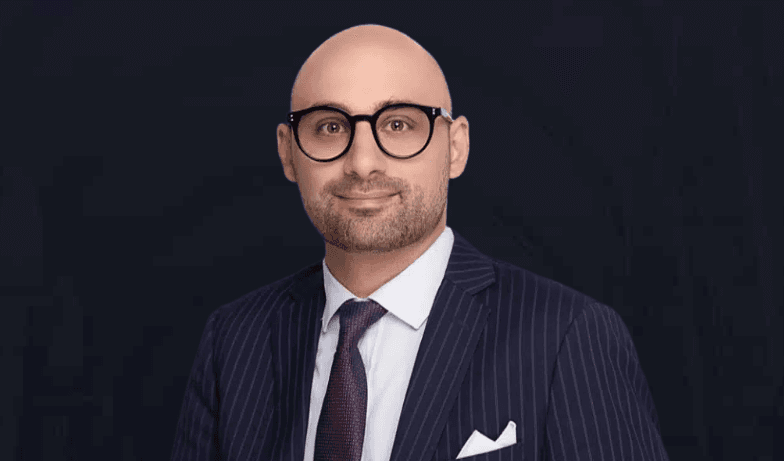

The February 2025 headlines were relentless. Tariffs on entire continents. Threats to withdraw from international organizations. A proposed $100,000 fee for H-1B visas that would fundamentally reshape skilled immigration. For most new immigration attorneys, launching a practice amid such chaos would seem impossibly daunting.
But Johannes Lazzaro wasn't most attorneys. And chaos, it turned out, was something he knew intimately.
Johannes Lazzaro: Attorney Profile and Immigration Law Background
Johannes Lazzaro brings a perspective to US immigration law that few practitioners can match. Born and raised in South Tyrol, a German-speaking province in northern Italy with a complex history straddling Austrian and Italian identity, he understands firsthand what it means to exist between worlds. After law school in Italy and early career work in commercial law, Lazzaro made a decision that would reshape his entire professional trajectory.
"I somehow didn't see a future in Italy," he reflects. "I was always the adventurous type, so I ended up in China."
Eight Years in China: Global Mobility and Business Immigration Experience
Those eight years, from the mid-2010s through the pandemic, gave Lazzaro a front-row seat to one of history's great economic transformations. Working with European corporations navigating market entry and expansion in China, he witnessed GDP growth rates between 5 and 10 percent annually. "It was really a lot of space, a lot of opportunities and interesting projects," he says. "It was a really nice time."
The work was commercial, not immigration-focused. Yet those years would prove invaluable for understanding how global talent moves, how bureaucracy can enable or impede business success, and how quickly political winds can shift the ground beneath professionals building international careers.
China's relationship with foreigners evolved dramatically during Lazzaro's tenure there. "You will notice that if you visit China, like, ten years ago, they'll be much more open and friendly," he observes. "Nowadays, you know, they've been riding the nationalist wave as well." He describes how, before COVID, being Western in China meant a certain status. By the time he left, that dynamic had fundamentally changed. "They were telling me, oh, Johannes, you're so lucky to be here in China. You're safe here."
COVID in Shanghai: Immigration Challenges and Global Mobility Restrictions
The Shanghai lockdown of 2022 became a turning point. While the rest of the world struggled through 2020, China's zero-COVID strategy initially succeeded. "In 2020, living in China, you would barely notice that COVID was a thing," Lazzaro recalls. But as variants evolved and the strategy collapsed, the reality of living in an authoritarian state became impossible to ignore.
"Even as a foreigner, living in a country like China, you know that you're in a totalitarian country, right?" he says. "But as long as it doesn't affect you directly, you don't really think about it that way." The arbitrary lockdowns changed that calculation. "These people, they can really take everything away from me, from one day to the other, for no reason."
The fear wasn't just about lockdowns. Any location visited by someone who later tested positive could trigger mandatory hotel quarantine for everyone who had been there. "You wanted to go to a cafe to drink a coffee, be like, oh, my God, should I really do this? Because what if someone positive showed up there like in the 14 days prior, they're gonna just put me in a hotel for 14 days."
From China to US Immigration Law: Johannes Lazzaro's Career Transition
Between COVID, the war in Ukraine, and shifting geopolitics, Lazzaro recognized there was no long-term future in China. He enrolled at George Mason University for a master's degree in US law, passed the bar, and faced the question that defines many career pivots: now what?
"That's where I really decided to step into immigration law," he explains. The decision was strategic and deeply personal. "Having these types of issues myself made me realize that I would be very much credible as an advocate for my clients. Because obviously, when you're in the same shoes, you really represent them better than someone who's not gone through the same type of process."
This perspective shapes everything about his practice. Where native-born attorneys might see forms and regulations, Lazzaro sees the human stakes of bureaucratic obstacles. "We really see ourselves as an enabler for people that want to succeed in life," he says. "We don't want to have the bureaucracy and the immigration process, which can be really tedious, get in the way of that."
EB-2 National Interest Waiver: Immigration Attorney Specialization
Lazzaro's practice focuses primarily on professionals and entrepreneurs, with particular expertise in the EB-2 National Interest Waiver. The NIW offers a path to permanent residency without employer sponsorship or labor certification, ideal for skilled professionals implementing projects in the United States.
"Usually the way it works is if you're a foreigner and you're looking to get an employment-based green card, your employer has to go through a process that is called permanent labor certification," Lazzaro explains. The process protects American workers by requiring proof that no qualified US candidates are available. "In today's economy, I think that people are going to find it more and more difficult to prove that no American worker is available to do that job."
The NIW bypasses this requirement for those who can demonstrate national importance in their work. "It's just a way for the government to say, what's in it for us? Why should we give you this benefit? What do we get in return?" Lazzaro says. His clients span diverse fields, from IT professionals and AI researchers to arms control specialists, each unique but united by being "on the top of their field."
Immigration Law During Political Uncertainty: Building a Practice in 2025
Launching in February 2025 meant starting a practice in unprecedented conditions. "I remember that it was a very difficult time because I was trying to focus on my project, but I would literally receive some completely insane news, like, every single day," Lazzaro recalls. "Trump is looking to get out of the United Nations. Trump is imposing tariffs on the entire world."
The proposed $100,000 H-1B fee particularly crystallized the challenges. "It doesn't make any sense," he argues. "In my opinion, it exceeds congressional powers." The Immigration and Nationality Act, he notes, stipulates immigration benefits through Congress. "If the Trump administration wanted to introduce a fee like that, they should go by Congress. They shouldn't just be issuing an executive order."
Beyond the legal questions, the practical impact concerns him. "No company will pay $100,000 to hire an H-1B worker. That's just not how it works." The majority of H-1B workers are young, relatively junior professionals, not senior executives. "Your typical client would come to the US to study, they are on a student visa, then they do something that is called optional practical training, which is basically a way for them to get into the workforce without having a work visa. And then they participate in the H-1B lottery."
If those pathways close, the long-term consequences could reshape American competitiveness. "In five years time you'll have less people applying for permanent residency," he predicts.
Why America Still Attracts Global Talent: Immigration Attorney Perspective
Despite the turbulence, Lazzaro remains fundamentally optimistic about America's position. "The US remains still a very attractive destination for anyone looking to do business," he says. The combination of regulatory environment, market size, and economic dynamism is unmatched.
"You have 350 million potential customers that all speak English, that are all fairly wealthy," he notes. "It's just something that you do not have on that scale anywhere else." Even wealthy smaller nations like Switzerland and Singapore can't compete on market size. Europe, his home continent, faces its own challenges. "I think that Europe right now is somehow somewhat at a point where urgent reforms are needed to bring the block back to competitiveness."
The comparison to China is particularly telling. Beijing recently launched the K visa, explicitly designed to attract those excluded from H-1B visas. But Lazzaro is skeptical it will succeed on a large scale. Seventy percent of H-1B holders are Indian nationals, and historical tensions between India and China make large-scale migration unlikely. "Virtually none of the Chinese tech ads work in India. They're all banned. So it's very hard for me to imagine that a Chinese tech company would be hiring an Indian national to work one of their projects."
More fundamentally, China faces cultural barriers to attracting international talent. "It's a very difficult country to live in," Lazzaro observes. "It's basically as foreign as it can get." The nationalist wave and increasingly closed mindset compound the challenges.
Immigration and US Competitiveness: Global Talent Competition Insights
"Even if you say, okay, rule of law in the US may be under pressure, that's still far better than any viable alternative that you have out there," Lazzaro argues. This comparative advantage, more than any single policy, explains why America continues winning the global talent competition.
His message to entrepreneurs and professionals considering the United States is direct: "If you have a good idea and you're looking to make it, the US still is the best place around."
At the same time, he acknowledges significant uncertainty. Short-term demand for immigration services remains strong, but long-term trends are harder to predict. "We need to see how that plays out, because I think there's a chance that long term, especially the higher end immigrants, may not be as attracted to the US anymore."
The courts, he believes, will play a crucial role. "The courts are going to have a big word, hopefully to say about what's happening and we'll have to see how things go."
The Path Forward: Immigration Law Practice and Global Mobility
Nine months into building his practice, Lazzaro brings on approximately three new cases monthly, primarily EB-2 National Interest Waivers. He handles intake calls personally, spending significant time evaluating potential clients and assessing their eligibility. It's a model that works for his current scale but one he recognizes will need to evolve.
The practice runs lean. Document collection happens through shared folders. Forms get filled by paralegals. He drafts letters in Microsoft Word, working with clients who are generally autonomous and capable of managing their own organization. "That's one of the advantages of working with high-end immigration," he notes. "They're usually very autonomous. They know how processes work."
His background in China gives him insight into immigration systems that few American practitioners can match. The Chinese system, he explains, historically had little immigration infrastructure but has transformed rapidly. "If you bring any value to the country, you can come, otherwise you stay home. That's basically what they're doing." The value can be either financial or expertise in strategic industries.
Immigration Compliance and Accuracy: Attorney Practice Standards
In the current environment, accuracy has become paramount. "You need to be really careful with how and what you submit," Lazzaro emphasizes. "Any small error is going to may potentially lead to a refusal." USCIS, he believes, is actively looking for reasons to deny. "They're just waiting for you to make any small mistake and deny your case."
Form updates have become particularly treacherous. "In the good old days when Biden was still around, they will give you a 60 days notice and say hey, we're going to update this form," he recalls. "Nowadays they just say hey, from today you need to have this new form and we're not going to accept the old one. And if it's already in the mail, we're still going to reject it."
These stakes make his personal experience even more valuable. Having navigated immigration bureaucracies himself, he understands the anxiety, the arbitrary waiting, the sense that one's entire future can hang on administrative decisions. It's why he describes his role as fundamentally enabling success rather than simply processing paperwork.
"We hope to continue in this path," he says. "We still believe that America remains, despite everything that's going on, a very attractive destination for foreign talents. It's not getting any easier. But still, I think that especially if you compare the alternatives, there's really no one that can really compete with America."
Immigration Attorney Johannes Lazzaro: Conclusion
From a German-Italian province to Chinese megacities to the corridors of American immigration law, Johannes Lazzaro has built a career on movement, adaptation, and understanding what it means to seek opportunity across borders. His practice exists at the intersection of personal experience and professional expertise, serving clients who share his own journey of betting on America despite uncertainty.
In an era of nationalist retrenchment and political chaos, his optimism stands out. Not naive optimism that ignores real challenges, but a clear-eyed assessment that even a flawed American system beats the alternatives. For entrepreneurs and professionals navigating the complex terrain of US immigration, that perspective, grounded in experience on three continents, offers both guidance and hope.
The bureaucracy remains tedious. The political environment remains volatile. But for those with the skills, determination, and vision to contribute, America's doors, Lazzaro believes, remain the most worth entering.
Johannes Lazzaro practices immigration law in Washington, DC, focusing on employment-based immigration for professionals and entrepreneurs. His practice specializes in EB-2 National Interest Waivers and serves clients across diverse industries and nationalities.



Bob Webber
SEP 16, 2025
Charles Kuck
SEP 15, 2025

Christa Byker
SEP 11, 2025