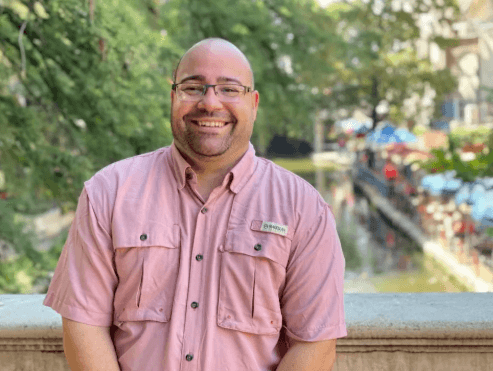

How a Puerto Rican Attorney Found His Calling in South Texas Immigration Reform
When Elket Rodriguez first arrived in Midland, Texas, a dusty oil field town in the heart of West Texas, the culture shock was immediate. Born and raised in Puerto Rico, where skin color and background blended across families like the shades of a rainbow, Rodriguez walked into a society that sorted people into boxes he had never known.
He started attending First Baptist Church in Midland and noticed something that would redirect his entire career. The church ran an English as a Second Language ministry, and the room was full of immigrants, most of them Mexican, all of them carrying the same unspoken question: What are my options?
"I come from Puerto Rico," Rodriguez says. "I could care less about your religious background or the color of your skin. We come in all the colors of the rainbow. If you look at a picture of my family, you're going to see all the shades."
He volunteered to teach. And then, naturally, the legal questions followed. Citizenship applications at first, the simpler end of immigration law. He helped Burmese refugees, Costa Ricans, families from across the globe. Most of them worked as custodians, janitors, and laborers. Most of them could not afford a lawyer.
That volunteer work in a church classroom in Midland, Texas, was the beginning of everything.
Elket Rodriguez's Early Career: Child Abuse Cases in Puerto Rico's Toughest Courts
Rodriguez did not come to the law gently. After finishing law school in Puerto Rico, he deliberately chose the cases no one else wanted: child abuse cases in the Bayamon region, one of the island's toughest jurisdictions.
"The first thing I decided to do as an attorney was to take on what people didn't want to take," he recalls. Losing those cases meant a child going back to a dangerous home. He wanted to test himself, to find out what he was made of under pressure.
He practiced family law and served the government in Puerto Rico for years, building a career grounded in high-stakes courtroom work. Then Hurricane Maria hit in 2017, tearing across the island and dismantling the infrastructure that held daily life together.
That experience left a mark that would surface later, far from Puerto Rico, in a different kind of crisis.
Moving to Texas: How Elket Rodriguez Discovered Immigration Law Through Community Need
After leaving Puerto Rico and landing in Midland, Rodriguez's trajectory shifted from family law to immigration, not through a strategic career decision, but through proximity. He was surrounded by people who needed help, and he happened to be an attorney who could provide it.
From Midland, he eventually relocated to Harlingen, a small city in the Rio Grande Valley, about 50 minutes from the U.S.-Mexico border. He joined a law firm and began taking on asylum cases in immigration court.
That is where his perspective began to change.
"You would always expect an impartial judge when you go to court," Rodriguez explains. "It's not that we did not have an impartial court or judge. It was just that you have a system that is so partial, so to one side, that it leaves little remedies or arguments to be made for your clients."
He describes immigration court as fundamentally different from civil or criminal proceedings. Judges are more involved in the direction of cases, legal creativity is essential, and yet the constraints of the system narrow the space attorneys can operate in. Appeals become lifelines. The margin for error is razor-thin.
Why Elket Rodriguez Left the Courtroom: The Case for Systemic Immigration Reform
Over time, Rodriguez came to a realization that would define the next chapter of his work: winning one case at a time was not enough.
"It really dawned on me that the issue went beyond taking one case, that this was a systemic issue, that there was a whole system that puts immigrants in a very tough position to defend themselves," he says. "There was a system of laws that needed to be addressed."
He points to a hard fact that most immigration practitioners know well: Congress has not meaningfully reformed immigration law in nearly three decades. The system is not merely under strain. It has been operating in a state of disrepair for an entire generation.
"I think my motivation comes more out of justice than it does from law," Rodriguez says. "I think that law should gear towards justice. And this is a system that needs to be reformed."
That conviction led him to step away from individual casework and move into full-time advocacy. He now serves as a Global Migration Advocate for a religious organization, working to mobilize faith leaders, equip pastors, and shift the conversation about immigration from a purely political framework to a moral and spiritual one.
Three Immigration Reforms Elket Rodriguez Is Fighting For
Rodriguez identifies three urgent areas of reform that drive his advocacy work.
The first is a pathway to citizenship for long-term undocumented residents. "They pay taxes and have essentially become Americans de facto, but not de jure," he says. These are people who have lived in the United States for years, contributed to their communities, and yet remain in legal limbo with no avenue forward.
The second is the DACA program. Rodriguez emphasizes that most DACA recipients have no real connection to the countries where they were born. "In their mentality, in their way of living, they were pretty much raised in the U.S., in our educational system," he says. "They are, again, de facto U.S. citizens without being U.S. citizens."
The third is asylum reform. Rodriguez argues that the American asylum system, born out of the lessons of World War II and the Holocaust, has drifted far from its humanitarian origins. He highlights the Cartagena Declaration, adopted by most Latin American countries in the 1980s, which expanded the definition of a refugee to include people fleeing generalized violence and massive human rights violations. The United States, by contrast, still recognizes only five traditional grounds for asylum.
"What we're seeing right now is that we may be deporting people who are actually refugees, but not necessarily considered refugees by us because of our laws," Rodriguez says.
He also raises an observation from his years in the courtroom that he believes is widely overlooked. Many asylum claims, he argues, have a religious dimension that attorneys fail to uncover because they focus too narrowly on political persecution grounds.
"Why didn't you join the gang?" he describes asking clients. "And then when you go deeper, they start telling you, 'Because I believe that you should treat others like you should treat yourself.' And I ask, 'Who said that?' And they say, 'Jesus.' And then, 'Where did you learn that?' They say, 'In church.'"
He encourages fellow attorneys to dig deeper into their clients' stories, to listen for the religious identity that may underlie an asylum claim and open a ground for protection that would otherwise go unexplored.
Faith and Immigration: How Elket Rodriguez Mobilizes Pastors and Church Leaders
Rodriguez's advocacy is built on a conviction that the immigration conversation belongs in churches as much as it belongs in courtrooms or legislative halls.
"I've always had a pastoral heart," he says. "Even when I worked in the law firm, people would call me not just to tell me their story, but also to ask for prayer. And it actually enriched their story."
He has watched clergy being arrested at the border. He saw it coming. For years, he has been working to prepare faith leaders, from pastors to lay volunteers, to support immigrant communities with practical help and moral clarity.
"If you go to a church, they're either the center of the community or tied to the community in some way," he says. "When all systems fall, the church is the only thing standing in a community."
He knows this from experience. When Hurricane Maria devastated Puerto Rico, the government's response was slow and insufficient. The churches filled the gap, providing food and aid when no one else could. That lesson never left him.
"That experience taught me that these pastors and leaders who are walking alongside, from any faith tradition, they have a say in this," Rodriguez says. "They live with the pain. They live with the people who are affected when the mom or the dad gets deported or gets detained."
His work today centers on training and equipping pastors and church leaders to mobilize on behalf of the most vulnerable, a calling he traces directly to the teachings of Jesus about serving "the least among you."
Elket Rodriguez's Nonprofit: Know Your Rights and Protection in South Texas
Beyond his advocacy role, Rodriguez runs a nonprofit in South Texas that provides food, shelter, and legal guidance to immigrant communities. The organization offers know-your-rights sessions and practical protection advice, work that has become increasingly urgent as Texas law enforcement has been deputized to assist with immigration enforcement.
"Your feet have to be grounded in the community," Rodriguez says. "Your feet have to be grounded with those who are in need."
He still does direct consultations, referred to him by pastors and community members. Sometimes he connects people with legal representation. Other times, he has to deliver hard truths.
"There are times when I have to tell them, 'Look, you don't have a case,'" he says. "And it is painful."
In the current climate, even when the legal advice he offers is information immigrants may have already encountered on a red card or in a community workshop, hearing it from an attorney carries a different weight. It eases the anxiety that has settled into daily life for so many families.
"In that essence, I am becoming sometimes more of a therapist than an attorney," Rodriguez reflects, "practicing chaplaincy in the sense of, 'I'm just here to listen to what you have to say, and I understand it.'"
What's Next for Elket Rodriguez: A Calling That Started Before Law School
When asked about the future, Rodriguez pauses. He is still assessing what comes next, even in the middle of the conversation.
But he returns to a story that has stayed with him for years. When he first decided to study law in Puerto Rico, he attended a church service where the preacher, herself an attorney, stopped mid-sermon and spoke directly to him. She told him that God was going to allow him to study law and become an attorney, but that he should not stay on that path for too long. He would be called back.
Rodriguez had never told her anything about his plans.
"I'm an attorney, so I still take many spiritual things with a grain of salt, even though you won't believe it because of what I do," he says with a laugh. "But I think that this is the moment I've been called to do this."
Whatever comes next, Rodriguez is clear about one thing: he will be where immigrants need him. In his community, on the border, in the churches, and in the rooms where the laws that shape millions of lives are being written and rewritten.
"I know that I have a part to play in everything that's happening in our country in this time, especially as it pertains to immigrants," he says. "I will be there. I have been there."


Bob Webber
SEP 16, 2025
Charles Kuck
SEP 15, 2025
Christa Byker
SEP 11, 2025