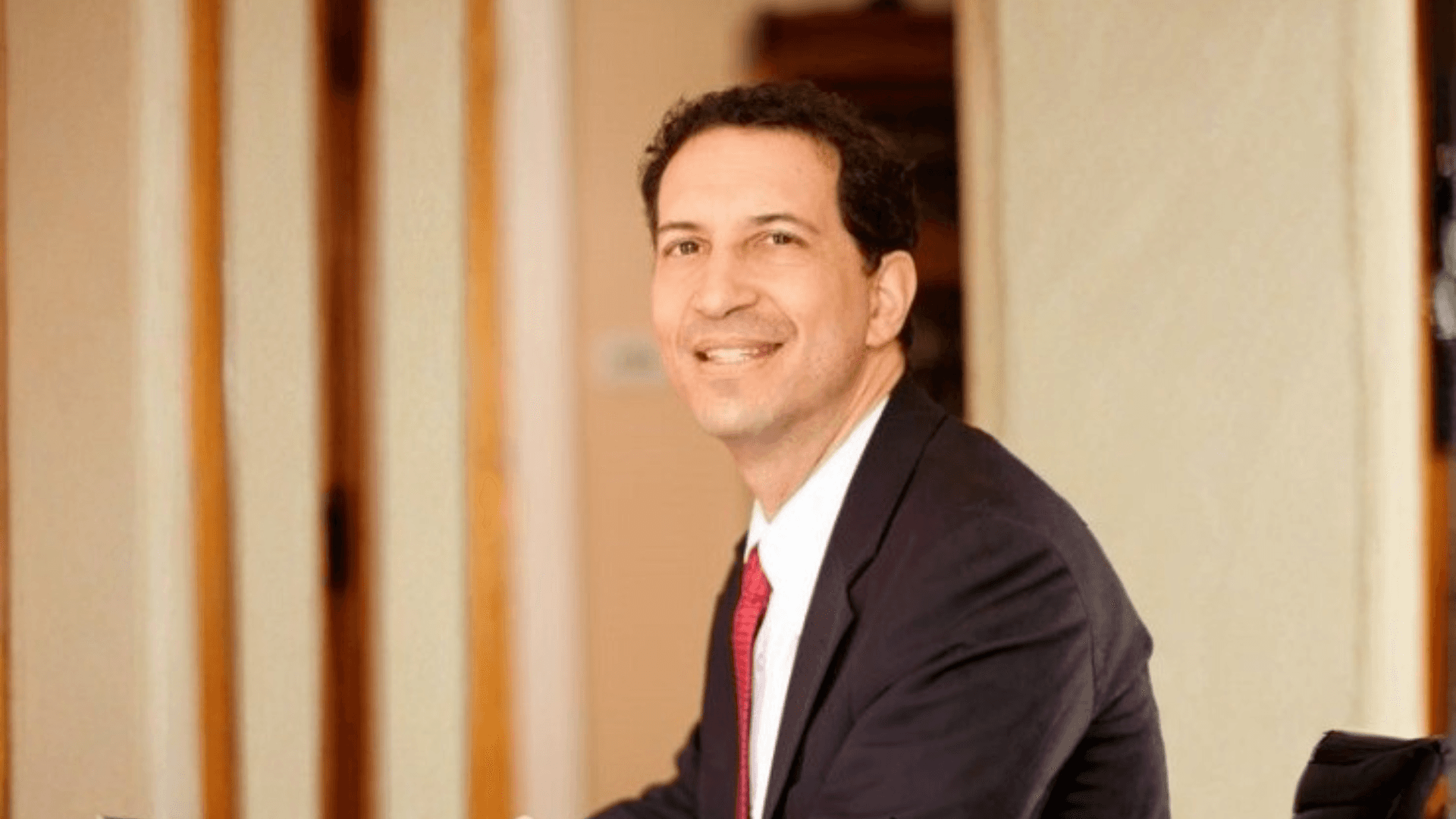

Dan Berger, Partner at Green and Spiegel and Academic Fellow at Cornell Law School
She was in her sixties, homeless at times, struggling with mental health challenges. A tourist visa overstay working under the table, she had spent years in the shadows of the American immigration system. When she walked into Dan Berger's office, there was no obvious path forward. No clean category. No easy answer.
Berger and his team explored every angle. They investigated potential labor law violations from her previous jobs. They examined whether a U visa for crime victims might apply. Nothing quite fit. The conversation could have ended there, another case filed away as impossible.
But Berger kept talking. And listening.
"She said, 'You know, I don't care so much about myself,'" Berger recalls. "Like a lot of parents say. 'What I really want to do is get a green card so I can bring my adult daughter over, get her out of a bad relationship in our home country. She has a daughter, and I want them to grow up here.'"
Then came the detail that changed everything: "I'm so proud of her. She just graduated from nursing school."
A light went off. There is a special streamlined green card for nurses, and nurse recruiters actively seek international talent to address the nursing shortage. Within months, the daughter arrived in the United States with a green card and a good job, able to provide a stable home for her mother. Five years later, the daughter became a citizen and sponsored her mother as an immediate relative.
"You said the story that warms your heart," Berger says. "There you go. But also, it was really about just listening to people and never thinking you have the right answer. Always trying to re-evaluate the plan."
Dan Berger's Path to Immigration Law: From Family Stories to Thursday Meetings
Like many who dedicate their careers to immigration law, Berger's connection to the field runs deep in his family history. His maternal grandparents emigrated from Ukraine in the 1910s, and despite being second or third generation American, he grew up immersed in stories, foods, and traditions that kept that immigrant experience alive.
"I knew my grandmother quite well and her family and heard stories," he explains. "So even though I'm now second generation or third generation, I still had that family immigration feeling."
That feeling found academic expression in college, where Berger took immigration history courses and volunteered teaching English to refugees, mostly Vietnamese and Russian in the 1980s. But the real breakthrough came after graduation, during what he describes as a "what do you do with a history degree?" moment.
Working as a high school teacher in Ithaca, New York, Berger accompanied some international students to meet with the local immigration lawyer. That lawyer happened to be a nationally recognized immigration professor at Cornell Law School who would become Berger's mentor for over three decades. The attorney invited the young teacher to attend their Thursday meetings, where practitioners would discuss their most challenging cases.
"I was just hooked," Berger says. "I just thought it was fascinating."
Those Thursday meetings revealed the true complexity of immigration law, a complexity that still defines Berger's approach today.
"I think what I really came to appreciate was just how immigration is constantly changing," he says. "The laws were passed at different times, so they're not really a coordinated structure. You're really trying to think about sometimes different provisions that weren't passed thinking about each other."
Dan Berger on Immigration Complexity: Why the System Defies Common Sense
Berger speaks about immigration law with the measured patience of someone who has spent decades explaining the unexplainable. His characterization of the field as "a game of categories" captures both its technical nature and its fundamental limitation.
"I think the biggest misconception is just that the system makes sense," he says. "Each individual rule might have had some organic basis, but the rules were passed at different times for different reasons based on different political compromises. The way the sausage of legislation is made is really a lot of throwing things together sometimes to get a compromise."
He illustrates this with a scenario that regularly confounds clients: international adoption. If a Greek American travels to Greece and adopts their sister's child through the Greek court system, there is no straightforward green card category for bringing that child to the United States. The adoption is legally recognized for state law purposes, but the immigration pathway is complicated, lengthy, and sometimes impossible.
"For a lot of people, that just seems completely unintuitive," Berger acknowledges. "But that's the way the law works, and that's the way it's set up."
This disconnect between intuition and regulation extends across the immigration landscape. There is no true entrepreneur visa. International student athletes earning money through name, image, and likeness deals operate in a gray zone the 1960s student visa regulations never contemplated.
"We have a lot of people who are trying to do something, but there's no good category that's set up to do what they want to do," Berger explains. "What we as lawyers have to do is try to see if there's any category that we can, in good faith, use to try to get where we want to go."
Dan Berger's Career at Green and Spiegel: Serving Higher Education
After law school at Cornell, where he worked as a research assistant on a major immigration law treatise, Berger spent a year as a mediator in the New Jersey court system before following his wife, a biology professor, to Northampton, Massachusetts. He wasn't certain immigration practice would be viable in a small town in an era when so much legal work still happened in person.
It worked. For nearly 25 years, Berger helped build a practice that became one of the only games in town for central New England. The geographic limitation became an unexpected asset, exposing him to an extraordinarily diverse caseload.
"Because of that, I got to do a lot of different kinds of immigration," he says. "I sort of joke that immigration is a game of categories and my bucket list is to try to have filed every category at least once. I still haven't done sheep herder or fashion model, but I've done quite a few categories that exist out there."
When his law partner was appointed to the Board of Immigration Appeals on short notice last year, Berger joined Green and Spiegel, a mid-sized firm of about 20 lawyers where he now focuses exclusively on representing nonprofits and educational institutions.
The timing, he notes, has been fortunate. "I really feel very lucky to be in a bigger team in this politically complicated moment because we can brainstorm, we can support each other. It's hard to keep track of everything. We can make sure we're sharing the latest information and also we can specialize a little more."
His work with universities and colleges spans three main areas: employment-based immigration for faculty and staff, institutional advising on policy and enforcement issues, and individual consultations for students and scholars in vulnerable immigration situations, including those who are undocumented, have asylum cases pending, or hold temporary humanitarian visas.
"There's always a danger that people will get their information from Reddit and from other sources," Berger observes. "We want to make sure that people are getting the best information so that they can make their best decisions in this complicated time."
Dan Berger on AI in Immigration Law: From Drafters to Editors
When asked about artificial intelligence, Berger draws an illuminating parallel to an earlier technological transformation: the emergence of websites.
"It reminds me a little bit of when we first started creating websites and it was hard, like you really had to know how to program," he recalls. "We were working in Joomla, I think, and now there are programs where it's just really user friendly. You could put up a website or use Mailchimp to send a really fancy email pretty easily."
He sees AI following a similar trajectory toward accessibility. "I feel as if AI is just at a different place where we can really have these conversations. These are tools, but these tools are becoming much more user friendly."
The practical application, as Berger sees it, is transforming roles rather than replacing them. "The way it was described to me is that AI can basically turn some of our employees from drafters into editors. I would never use AI as a final product, but I think there may be situations where creating cover letters or putting together packages or figuring out ways to move data into different formats or onto forms could be very helpful."
The key, he emphasizes, is maintaining human oversight: "A human being needs to, a lawyer needs to look at the final product very carefully and compare everything."
Trends in Higher Education Immigration: Communication and Support
Beyond AI, Berger observes a fundamental shift in how immigration information reaches its audience, particularly in the university context.
"Lawyers are often the last ones to jump on the train," he admits. "Lawyers were doing old-fashioned dictation with an administrative assistant really after a lot of people had started using word processors. We tend to, I think as a profession, not always be the fastest at picking up new technology."
But necessity has forced adaptation. Where the instinct might once have been to send an email, a blog post, or a text-heavy FAQ when something new happens, Berger now conducts one to three town halls per week for university clients.
"We want to share and have it be interactive and have something that people can absorb," he explains. "I think there's something comforting about seeing a person instead of just getting an email in this political environment."
He recently recorded a three-minute Instagram video on H-1B basics for the City University of New York, a format that initially felt constraining. "I was a little tense at first because I wanted to clarify a nuance and I probably could have talked for an hour on that particular topic," he says. "But I think it got the big picture out to people."
The broader trend he has observed in higher education: "Things are getting harder and slower, and so universities are having to provide more support and more encouragement for international students. Little mistakes can be big problems in this era of extreme vetting."
Dan Berger on Policy Reform: Reducing Subjectivity at the Border
Asked what single policy change he would make if given the power, Berger points to Section 214(b), the temporary intent provision that allows consular officers to deny temporary visas based on a subjective assessment that an applicant might intend to stay in the United States permanently.
"It gives a consular officer the ability to just say no to somebody who wants to visit as a tourist or come here as a student or be a postdoc or be a medical trainee just for this vague temporary intent," he explains. "It's antiquated, and it's really hard. It just creates that subjectivity where a consular officer that just doesn't seem to like the situation can say no and it's unreviewable."
For students, postdocs, and scholars in particular, he believes eliminating this provision would remove an arbitrary barrier that serves little purpose beyond enabling bias.
Advice for Aspiring Immigration Attorneys: The Journey, Not the Race
Reflecting on his career, Berger offers counsel that runs counter to the urgency many young lawyers feel to specialize immediately.
"I would say try to have different kinds of experiences," he advises. "At various points during law school, I worked in the legal aid clinic. I worked in, I spent a summer at a big firm. I worked for the immigration treatise. I worked in the court system."
The through line of his guidance is patience: "This is a journey, not a race. Try to take some time to have different experiences and they all kind of inform each other."
Beyond his practice at Green and Spiegel, Berger serves as an academic fellow at Cornell Law School, where he runs a clinic for Dreamers exploring employment-based pathways to status and contributes to broader immigration policy discussions.
The Art of Listening in Immigration Law Practice
That story of the woman in her sixties, the one who just wanted to bring her daughter home, keeps returning because it encapsulates everything Berger has learned about practicing immigration law effectively.
The system is complex, often arbitrary, built from decades of political compromises stacked upon each other without coordination. The categories are rigid, the stakes are life-altering, and the margins for error are thin. But within those constraints, solutions exist for those willing to keep asking questions.
"Sometimes you just learn things when you keep talking," Berger says. "It was really about just listening to people and never thinking you have the right answer."
Three decades after walking into those Thursday meetings in Ithaca, Dan Berger is still listening, still finding categories, still proving that even in a system that defies common sense, the right conversation can change everything.
Dan Berger is a Partner at Green and Spiegel, where he focuses on representing nonprofit organizations and educational institutions. He also serves as an Academic Fellow at Cornell Law School.




Bob Webber
SEP 16, 2025

Charles Kuck
SEP 15, 2025

Christa Byker
SEP 11, 2025