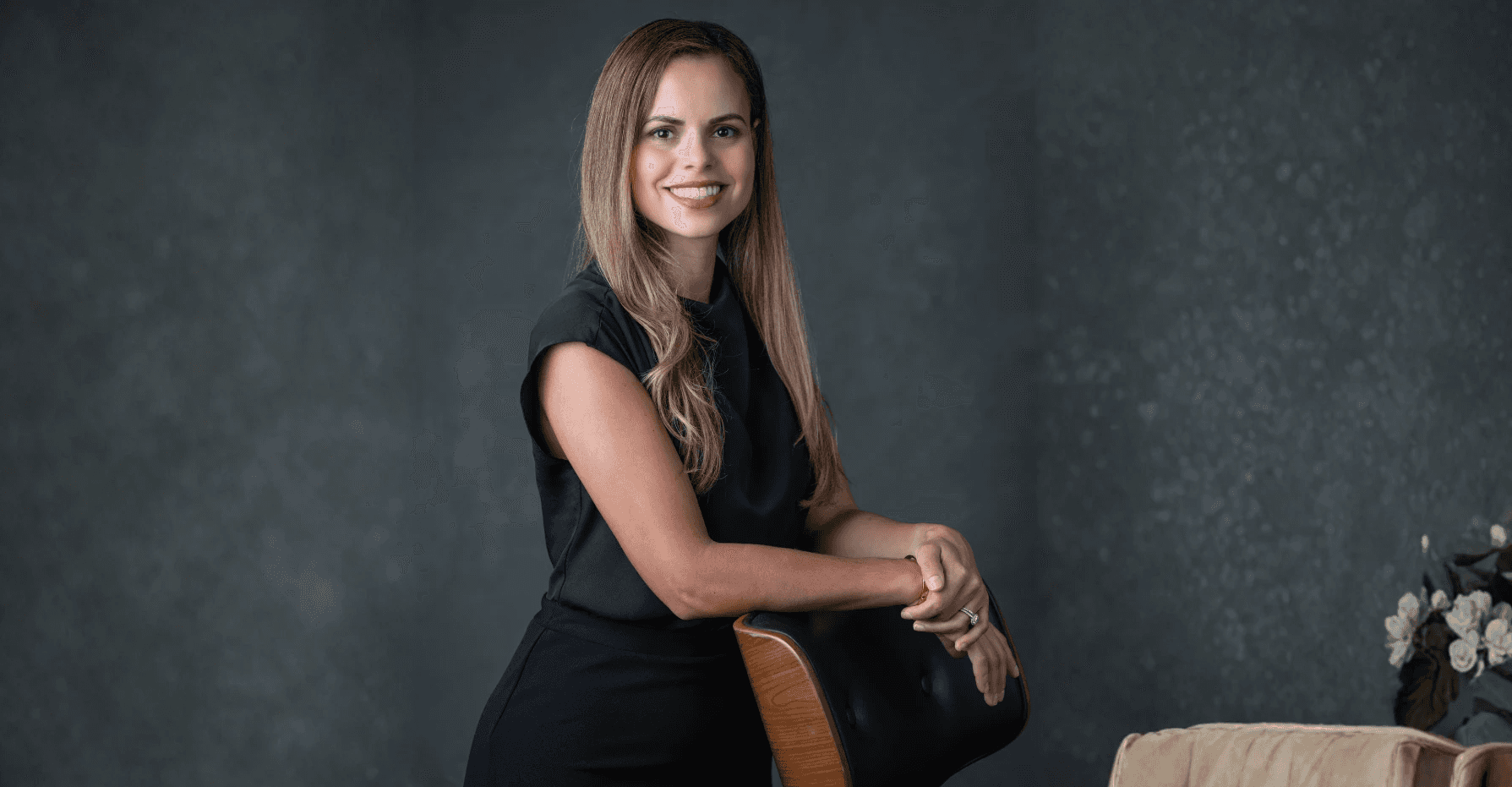

How This Brazilian-Born Lawyer Built a Thriving Immigration Practice by Embracing Uncertainty
Ingrid Borges Perez is the founder of her own immigration law firm based in Orlando, Florida, specializing in employment-based immigration for STEM professionals and engineers.
The floor could open up at any moment and swallow you whole.
That is how Ingrid Borges Perez describes what it felt like growing up undocumented in America. For nearly a decade, from the age of ten until her early twenties, she lived with that constant, gnawing uncertainty. It is a feeling she says many immigrants still experience today as they navigate a system that often seems designed to keep them guessing.
Now, as the founder of her own immigration law firm in Orlando, Florida, Borges Perez has turned that childhood anxiety into a career dedicated to helping others find solid ground.
From Brazil to New York: An Immigrant's Beginning
Ingrid Borges Perez arrived in the United States in February 1994, one month shy of her tenth birthday. Her mother had brought her and her brother from Brazil in search of a better life. The family landed in New York in the dead of winter.
"I had never seen snow before," Borges Perez recalls. "I was a little kid thinking we were going to have this amazing life right away. And of course, that's not the case."
The family came on tourist visas. They never left.
For nearly ten years, Borges Perez lived as an undocumented immigrant, watching her classmates plan for college while she wondered if she would ever have that option. "I was going to be a dreamer," she says. "I didn't know what my life was going to be like. It was very sad and just so disappointing and heartbreaking because I came as a kid."
Eventually, her mother secured employer sponsorship and, thanks to a Clinton-era provision to the U.S. Immigration and Nationality Act (INA), the family obtained permanent residency. The door to college finally opened.
A Winding Path to Immigration Law
Borges Perez did not take a direct route to becoming an immigration attorney. After earning her undergraduate degree, she became a teacher for two years. Then she made a decision that surprised even herself.
"I wanted to go to law school because why not? I like the challenge. I like doing hard things," she explains. "I didn't know any lawyers. I didn't know anything. I just wanted to be a lawyer."
She enrolled at Fordham Law School in New York City. After graduating, she spent five years as a public defender in Manhattan, an experience she describes as transformative. She was in court every single day, handling trials and hearings, watching complex legal arguments unfold before juries.
"Every single day was different and it was exciting," she says. "I learned so much."
But in 2018, when she and her husband decided to move to Florida to be closer to family and escape the cold, Borges Perez saw an opportunity to pivot toward what she had always wanted to do: immigration law.
"I just started to kind of put it out in the universe that I'm an immigration lawyer now," she recalls, "and it just kind of slowly opened the door in many different ways."
The Power of Working Backwards
Today, Borges Perez runs her own firm, focusing primarily on employment-based immigration for STEM professionals. She has helped engineers, scientists, and physicians navigate the complex pathways to permanent residency. But the philosophy that guides her practice extends far beyond legal strategy.
"I've learned that I have to work backwards," she explains. "I have to figure out where I want to be and work backwards from there. And I don't think we need to be humble about it. I think we need to be loud about it and really say, this is the goal that I want to achieve. This is the impossible dream, and we got to go for it."
This advice, she notes, applies equally to entrepreneurs building businesses and immigrants charting their path to the United States.
When prospective clients come to her, she asks a simple but essential question: What is your ultimate goal?
"Is your ultimate goal to live in the United States as a permanent resident, or do you want to come here and try it out?" she says. "Because depending on the ultimate goal, you may have different routes."
Advice for Immigrants Navigating the System
For immigrants currently on employer-sponsored visas like the H-1B, Borges Perez offers direct counsel: seek independent legal advice.
"When you're going through the immigration process through an employer, that case belongs to the employer. You're the beneficiary," she explains. "You're not necessarily going to be the primary client of that attorney. So you need to seek out your own independent legal advice."
This matters, she emphasizes, because immigration is extraordinarily fact-specific. Two people on the same team with the same visa can have vastly different paths forward based on country of birth, priority dates, marital status, and dozens of other factors.
"You can have twenty people working with you on your team with H-1Bs, but they each have a different path," she says. "I think it's so important to just know exactly how it applies to you so you can start identifying your options, your limitations, what you can do, what you can't do."
Understanding this empowers immigrants to take control of their own journey, which is often why people pursue self-petitioned pathways like the EB-2 National Interest Waiver or EB-1A.
Stories That Stay With You
Among the many cases Borges Perez has handled, a few stand out as reminders of why she does this work.
One recent case involved a physician from Nigeria who had come to the United States on a student visa to pursue a master's degree in public health. After passing his medical boards, he began working on an H-1B. But a series of setbacks followed: a denied EB-2 National Interest Waiver petition, a green card application that was subsequently denied, COVID-related delays, and a period when he was supporting a family of five on $70,000 in California while unable to practice medicine.
"He came to me after his green card application had been denied," Borges Perez recalls. She got him back on H-1B status, then worked with his employer to file a physician National Interest Waiver, a case type she had never handled before.
"I didn't want to take this case because I was like, I don't know how to do this," she admits. "I sent him to a bunch of different lawyers. He said, no, I just want to work with you. I trust you."
The petition was approved just weeks ago. The doctor is now practicing medicine, earning well, and serving an underserved community addressing the drug epidemic.
"It just goes to show that even a very intelligent doctor couldn't quite get the immigration process right," Borges Perez observes. "There are wrinkles that happen along the way. But in this case, a good thing ended up happening to somebody who really deserved it."
Another client who left a lasting impression helped his country launch its first two satellites into space. Borges Perez guided him through his EB-1A petition to the moment he received his green card. When he arrived in the United States with his family, he visited her Orlando office in person.
"People hire me without knowing me, which is really amazing," she reflects. "Now I see him going to the White House and doing things in Europe and going to NASA. It's such a treat."
A Thoughtful Approach to Artificial Intelligence
On the topic of AI in immigration practice, Borges Perez takes a measured stance. While she sees potential in AI for certain operational tasks, she remains skeptical of AI-generated writing in legal submissions.
"I don't allow my clients to use AI," she says. "I work with a lot of people in tech and these tech concepts are hard enough to understand without AI. You need to human it down. Not even dumb it down, just human it down."
She believes immigration officers can detect AI-generated content, and that the proliferation of AI-written petitions is affecting the entire system.
"An immigration officer who's reviewing ten cases a day, reading eight out of ten that is written through AI, that's going to tire you out. That's going to put you in a bad mood. That's going to be very difficult to adjudicate."
Her preference is clear: "I'd rather have an imperfect draft by a person rather than AI, just because AI has a lot of filler."
Don't Compare Your Journey
As our conversation draws to a close, Borges Perez offers a final piece of wisdom that reflects both her professional experience and personal journey.
"It's very easy to feel down because somebody was able to get a green card in five months and here you are five years unable to get it," she says. "Same thing with business. Somebody was able to grow their law firm to be this amazing thing and here you are struggling."
Her counsel is simple but hard-won: "Don't compare. Everybody goes through the struggles. It's never easy, no matter what you're doing. Your journey is going to look different than somebody else's. Take inspiration from everyone else, but know that you have to carve your own path."
For someone who once felt the floor might open up beneath her at any moment, Borges Perez has built something solid. And every day, she helps others do the same.
Ingrid Borges Perez is an immigration attorney and founder of IBP Immigration Law in Orlando, Florida. She specializes in employment-based immigration for STEM professionals, engineers, and physicians. Connect with her firm to learn more about your immigration options.




Bob Webber
SEP 16, 2025
Charles Kuck
SEP 15, 2025

Christa Byker
SEP 11, 2025