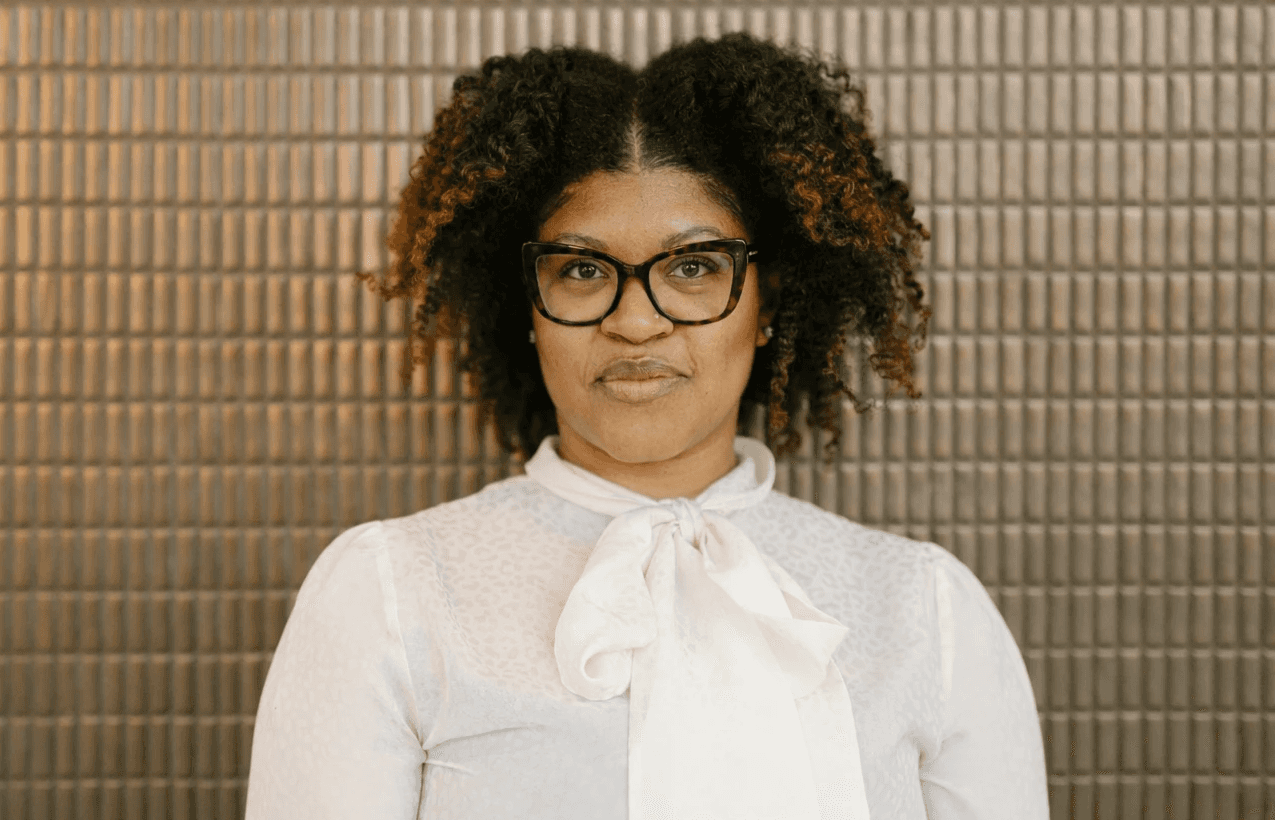

How a Law School Assignment Revealed Her Calling and Shaped a Career Spanning Trump-Era Challenges
How Samantha Hamidan of Yunus Law Discovered Her Immigration Calling Through Her Grandmother's Journey from Haiti
It started with a homework assignment.
Samantha Hamidan was a second-year law student at Cardozo Law School, enrolled in an immigration clinic, when her professor gave the class an unusual task: go home, talk to your parents, and learn your family's immigration story. "Because everyone in America has an immigration story," the professor explained.
Hamidan went home and asked her father, who was born and raised in Guyana, a former British colony in South America that identifies as part of the West Indies. His response surprised her.
"He said, 'Oh, you have to talk to your mom, because she's the one who petitioned for me,'" Hamidan recalls. "And I hadn't known that. I was in my 20s. It was really interesting to find out."
What she discovered was a story that stretched back to Haiti, where her grandmother had first come to America as a nanny for a family. That grandmother eventually sponsored the rest of the family, including her four siblings. Today, the family has spread across North America and France, with relatives in New York, Boston, and Montreal.
"My family is West Indian," Hamidan explains. "My mother's Haitian. My father's Guyanese, and my father's a pastor. He pastored a church in the Bronx when I was young, and it was all Jamaicans."
That heritage would prove unexpectedly valuable in her very first immigration case.
Samantha Hamidan's First Case: Translating Patois for the Second Circuit
The immigration clinic at Cardozo was intense by design. Students weren't just reading case law from the 1800s; they were representing actual clients with real deportation threats. For Hamidan, one case stands out: an elderly Jamaican woman, nearly 90 years old, whose case had escalated all the way to the Second Circuit Court of Appeals.
"We worked so hard that semester on a brief to the Second Circuit, which was insane for me to even say," Hamidan remembers. The students visited the woman's home in the Brooklyn neighborhood of Brooklyn to gather information. What they found was a scene that felt deeply familiar.
"Her accent, her patois was so strong that the professor was like, 'What is she saying? What is going on here?'" Hamidan laughs. "So now I'm kind of translating her patois so that everybody understands where we are."
The woman had a great-grandson running around, something cooking on the stove. "It was so familiar to me because it's kind of the way that I grew up in Queens," Hamidan says.
That case taught her something crucial: immigration law becomes an entire family affair. She had the client's daughters’ number saved in her phone. The stakes were personal, the relationships deep.
Navigating the First Trump Administration: Muslim Bans and Airport Chaos
That same semester brought a seismic shift. It was fall 2016, and Donald Trump was elected president. Everyone in the immigration world felt the ground moving beneath their feet.
"Everybody kind of felt like things are going to be changing," Hamidan recalls, "and they were right."’
By January 2017, Trump had been sworn in, and the first iteration of the Muslim ban created chaos at airports nationwide. People were arriving uncertain of their status. Lawyers and law students rushed to airports to meet incoming travelers.
Hamidan reached out to the New York Civil Liberties Union and began doing research for them while still in law school. At the same time, a mentor's words kept echoing in her mind. Her friend Ana Gabriela Urizar, an immigration practitioner who went on to be an associate at Fragomen told her something that would become a guiding principle: "You can't let anybody stop you. If you want to do immigration law, there's a million different paths that you can take in immigration."
Removal defense. Business immigration. Family petitions. Naturalizations. The field was vast, and Hamidan was beginning to see all the doors that were open to her.
Samantha Hamidan's Immigration Moot Court Victory at NYU
While the political landscape shifted, Hamidan was also competing on Cardozo's First Moot Court honor society, practicing mock Supreme Court oral arguments. Two of her friends discovered an immigration-focused competition at NYU, just down the block from Cardozo. But there was a problem: it wasn't on the main slate of competitions, so funding and support were scarce.
"Immigration's a really specific topic," Hamidan explains. They made a practical argument: they didn't need hotel accommodations or travel funding since the competition was walking distance away. But the school still wouldn't provide the usual team of six or seven supporters.
So they went with what they had: two competitors Danelly Bello and TaLona Hisheik, Hamidan, and one other friend helping with immigration research.
"These two ladies, they were so stellar," Hamidan says. "We took it all the way. We went to the finals and they won."
It was an incredible victory, made more remarkable by their limited resources. And it led directly to Hamidan's next opportunity. Through the competition, she met attorney Liz Ames, a solo practitioner in Harlem who specialized in O-1 extraordinary ability visas and EB-1A green cards for artists.
"I reached out to her to ask if I could intern with her that summer," Hamidan says. "She accepted. And that was my first foray into the world of business immigration."
In the span of about nine months, Hamidan had experienced the full spectrum of immigration law: a complex removal case involving an elderly Jamaican woman, research during the Muslim ban chaos, a hypothetical competition case based on the intersection of criminal and immigration law and now business immigration for artists. Her mentor's words rang true: there was no one way to be an immigration attorney.
From WR Immigration to Yunus Law: Building a Business Immigration Practice
After law school, Hamidan spent 1 year at Merrill Cohen and Associates before starting at WR Immigration in Dec 2019 and then five years at WR Immigration, one of the biggest names in the field. The scale was massive. She would sit down every week with clients who had 50+ employees needing immigration support. These were Fortune 500 multinational organizations organizations with complex, ongoing needs.
It was at WR that Hamidan first encountered sophisticated AI-powered case management through their proprietary software, WRapid™. "It's honestly probably one of the best softwares I've ever worked with," she says, "because before anybody knew what AI was, we were building out this software and it's learning from us and we're learning from it."
The technology evolved during her tenure, moving from simple questionnaire population to reading receipt notices, generating emails, and automating case workflows. For a volume-based practice, these tools weren't luxuries; they were necessities.
In February 2025, Hamidan made a significant transition. She joined Yunus Law as supervising attorney, partnering with founder Afia Yunus to build something new. The firm operates as a full-service immigration practice from their office in Melville on Long Island. Hamidan heads up business immigration: national interest waivers, O-1s, L-1 intracompany transfers, E-2 investor visas, and H-1Bs.
"It's interesting because I had tried to shy away from things like humanitarian cases, removal defense, and so now I'm kind of back in it," she acknowledges. About half the firm's cases are family-based, including adjustments, petitions on behalf of family members, and naturalizations.
The partnership came together in an unexpected way. Hamidan and Afia Yunus met at an AILA conference in December 2024, where they were both speaking on a panel about cybersecurity and ethics in the age of AI.
"That was when everyone was starting to hear about AI," Hamidan recalls. "Lawyers are notoriously old school. So everybody's kind of like, 'What are they talking about?'"
Samantha Hamidan on AI in Immigration Law: Helpful But Human Oversight Remains Essential
Hamidan has a nuanced view of artificial intelligence in legal practice. Having worked with sophisticated case management AI before the current boom, she sees both the promise and the limitations.
"I do think it's very helpful if somebody or something is going to read my receipt notices and let me know," she says. "That's awesome. I don't have to read them myself."
But when it comes to client communications, she's more cautious. "I am, and probably most lawyers are, a bit of a control freak. Am I going to let somebody else write my emails? I don't know yet. I'm not there yet because I'm still going to have to edit it. I'm still going to have to look at it and make sure that it's saying what I want it to say."
The goal of AI, as she sees it, is to supplement the practice, making work more efficient and potentially giving attorneys some time back. A networking group she belongs to recently held a roundtable on the best AI tools for practitioners. The interest is real.
But Hamidan draws a line. Her work with clients has exposed her to fascinating AI applications, from audio deepfake research to food security engineering that could extend produce shelf life. These uses impress her. What doesn't? AI-generated music.
"There are certain things that must have a human impact," she says firmly. "Music has to have soul."
On the regulatory front, Hamidan predicts eventual federal oversight but doesn't expect it soon. "In the U.S. specifically, I think Congress is a little slow and focused on a lot of other things at the moment and not AI regulation," she observes. “Europe is ahead. Individual states are filling the gap. By the time federal regulation arrives, it may be late from a privacy and security standpoint.”
Despite her forward-thinking approach to technology, Hamidan admits to some old-school habits. "I am still like that old head taking notes with a physical pad and paper. That is still me."
A Dominican Family's Two-Year Immigration Saga: L-1 Visas, Expired Status, and a Critical Win
Among Hamidan's most memorable cases is a Dominican family she met between jobs, during the week she took off before starting at Yunus Law. The case was a two-year saga when it came to her that tested every skill she had.
By that point, it had been nearly a two-year saga for the clients, their original EB-1C petition had been filed in April 2023, and the appeal was not finalized until late 2024. Although Samantha worked on the matter for only a matter of weeks, the clients were onboarded before her first day at Yunus Law in February 2025. She filed the new EB-1C petition on February 11, 2025, which was approved on February 26, 2025. The clients’ visas were subsequently approved on April 4, 2025. She is now working with the clients on additional EB-1C cases.
The family had come to the U.S. on L-1 intracompany transfer visas. They filed for green cards under the EB-1C category for multinational managers, along with adjustment of status applications for the husband, wife, and two daughters. Then the EB-1C was denied and sent to appeal.
While the appeal wound through the system, their L-1 visas expired. They had been advised, in Hamidan's view improperly, that they didn't need to extend them.
"I had a heart attack when I heard that," she says. "Why would you not maintain your underlying status? I was really nervous."
During what was supposed to be a vacation week in St. Croix with her sister, Hamidan dove deep into the family's situation. She tracked dates, calculated potential unlawful presence, worked to update their I-94 entry records. One family member had an expired passport, creating additional complications. Customs at JFK wouldn't extend the entry record because of the passport issue.
The solution? File new L-1 petitions and send the family to the consulate in Santo Domingo.
"I said, listen, we have to file new L-1s. I'm going to send you to the consulate, and it could be two weeks, it could be six months. We're just gonna have to see."
The L-1 was approved in less than two weeks, which Hamidan didn't see coming. But then came the appointment problem. The family was in the Dominican Republic, their children pulled out of school, and the State Department website kept crashing. No appointments were showing. The kids had been out of school for almost a month.
Eventually, the consulate granted an expedite request and simply reached out with an appointment time. Hamidan was still nervous about one family member's I-94 issue. She had written a detailed memo, just in case, and gave her client clear instructions: "Over document but under explain. If they ask you a direct question, you respond to the direct question, and that's it. We're not extrapolating."
The consular officer didn't ask. The family got their visas. They returned to the U.S. A month later, their adjustments of status were finally closed out.
"Even though the green card itself wasn't approved, the underlying status is the portion that we were able to save," Hamidan reflects. "To me, that was such a critical win because it means that your children can continue in the environment that they're now accustomed to."
One of the daughters had special needs and was enrolled in a school particularly well-suited to support her. Preserving the family's status preserved that stability.
Staying Current in Turbulent Times: H-1B Changes, Policy Shifts, and Savvy Clients
Having practiced through multiple administrations, Hamidan is no stranger to rapid policy changes. The current environment, with its proposed $100,000 H-1B fees and ongoing legal battles, feels familiar in some ways.
"This is something that we saw in the first Trump administration as well," she notes. "Changes happening, lawsuits, things are paused. The court says something, somebody agrees, somebody doesn't, somebody appeals. Everything's paused. It's just kind of always a lot of back and forth."
What strikes her most is how informed her clients have become. During a recent government shutdown, a client called to ask whether the Office of Foreign Labor Certification was still open.
"I'm like, I just found that out yesterday. I just learned of this news yesterday, and they're already picking up the phone to call me," Hamidan laughs. "Our clients are very savvy. There's a lot of things that they know that I don't. But for immigration law, it's our job to really know what's going on."
Samantha Hamidan's Tribute to Immigration Support Staff
As the interview concluded, Hamidan wanted to make one thing clear: attorneys don't do this work alone.
"There's a lot of focus, obviously, on immigration attorneys and practitioners," she says. "We wouldn't be able to do any of this without our team members. I have an incredible team, a stellar team. They are always there and they are always holding it down."
The paralegals, law clerks, receptionists, interns: these are the people who keep immigration practices running, especially during turbulent policy periods.
"Those are really the superheroes because they're the ones who are getting it done," Hamidan says. "I have a lot of love for anyone I've ever worked with as a paralegal, legal assistant, any of that."
Some of those colleagues still reach out. They get together and hang out. Hamidan offers to serve as a reference for people she worked with remotely for three years and never met in person.
"I know your work ethic and I know how integral you are," she says. "I just want to give a big thank you to all the support staff. It's critical."
Looking Ahead: Expanding Yunus Law on Long Island
For Hamidan, the future is about growth. She joined Yunus Law with a clear proposition: she wanted to come in at a certain level and help expand the practice. The firm has a beautiful office space in Melville. Things are moving.
The journey from that law school homework assignment to her current role has taken her through removal defense, humanitarian cases, artist visas, multinational corporate clients, and now a collaboration where she can shape the firm's direction. Through it all, she has held onto the lesson her mentor taught her years ago.
There's no one way to be an immigration attorney. And for Samantha Hamidan, that truth has made all the difference.
Samantha Hamidan is a supervising attorney at Yunus Law in Melville, New York, where she heads business immigration and general practice. She was named to Best Lawyers in 2024 and 2025 and previously spent five years at WR Immigration. She is a graduate of Cardozo Law School Georgetown University.




Bob Webber
SEP 16, 2025
Charles Kuck
SEP 15, 2025

Christa Byker
SEP 11, 2025