
Nicolas Gonzalez Discovers His True Calling in Immigration Law After Years of Searching
La Raza Community Resource Center Attorney Reflects on His Journey from Exploration to Advocacy in San Francisco's Mission District
Nicolas Gonzalez remembers the moment of clarity with perfect precision. Sitting at his desk as an education attorney, helping families navigate special education rights for their children, he couldn't shake a persistent feeling. The work was good, meaningful even, but something essential was missing.
"I was constantly thinking, yeah, you know, I'm doing good work. But I just feel like this isn't for me," Gonzalez recalls. "I'm having this constant battle where I feel like I'm denying what I should really be doing and what I really want to be doing, which is immigration work."
That realization would lead him to La Raza Community Resource Center in San Francisco's Mission District, where today he serves as an immigration attorney helping the very communities that shaped his childhood. His journey to this point, however, was anything but straightforward.
Growing Up Surrounded by Immigration Stories
For Gonzalez, immigration has always been personal. Born and raised in the San Francisco Bay Area, he grew up immersed in one of America's most diverse immigrant communities. His father immigrated from Mexico at just 14 years old. His maternal grandfather participated in the Bracero program, a guest worker initiative that allowed agricultural workers to travel between Mexico and the United States before he eventually decided to settle permanently and raise his family in America.
That environment in the heart of the Bay Area, where encounters with people from different countries became part of daily life, planted seeds that would take years to fully bloom. Yet even as these experiences shaped him, Gonzalez initially resisted what seemed like the obvious career path.
The Long Road of Exploration
When Gonzalez entered law school, immigration law certainly crossed his mind. But rather than immediately pursuing what felt natural, he chose a different approach: systematic exploration. He wanted to be certain he wasn't simply following expectations or taking the easy route because of his background.
"I was like, okay, of course it'd be natural for me to go into immigration, but maybe I should try to break the mold," he remembers. "Maybe I should look for something else, explore different areas just to make sure I know what else is out there."
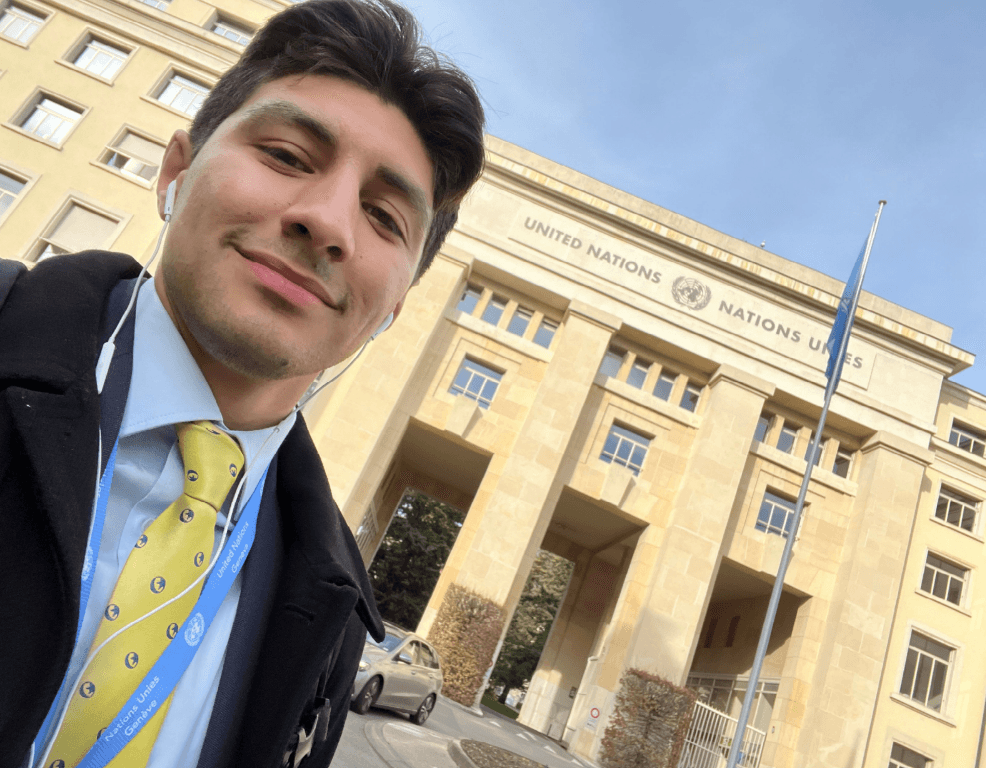
The exploration was thorough. He interned at the public defender's office, gaining exposure to criminal defense work. He completed an externship at the Federal District Court of Northern California in Oakland, drafting judicial orders for habeas corpus petitions. He even traveled to the United Nations in Switzerland to advocate for LGBTQ rights, testing whether international law might be his calling.
"I also did some international law work. I even had an opportunity to go to the UN in Switzerland to advocate for LGBTQ rights over there," Gonzalez notes.
After graduating from law school, his first attorney position took him further from immigration work. As an education attorney, he helped families ensure their children with special education needs received proper support and services. The work served vulnerable communities, aligned with his values, and made a genuine difference in people's lives.
But it wasn't immigration law.
The Pull Back to Immigration
Even during his exploration period, immigration kept resurfacing. In law school, Gonzalez took courses in asylum law and immigration policy. He worked on an asylum case with one of his professors and found genuine satisfaction in the work. He advocated for stronger immigration policies with government officials. The exposure was limited compared to other areas he explored, but the connection he felt was undeniable.
"I had some experience and some exposure there, and I really enjoyed doing it," he reflects.
That enjoyment contrasted sharply with the growing sense of disconnection he felt in his education law position. The internal conflict intensified until he could no longer ignore it.
"I finally said, you know what, let me go for this immigration work that I've been really wanting to do," Gonzalez explains. "This is what I really want to be doing. It's time to actually commit to it."
The timing proved significant in ways he couldn't have anticipated. His decision to commit fully to immigration law coincided with the beginning of a new presidential administration in 2025, one that would dramatically transform the landscape of immigration enforcement and create unprecedented challenges for immigrant communities.
Finding His Place in the Mission District
When Gonzalez joined La Raza Community Resource Center, he found himself working in the heart of San Francisco's Mission District, a predominantly Latino neighborhood filled with immigrants from across Latin America. The location felt like coming full circle.
"I just feel like being here, I've been able to really connect with my roots, really help out the people who have been a part of my community for my whole life," Gonzalez reflects. " I grew up with immigrants. I grew up in a Latino household. And that's the community that I feel that I'm a part of. And it feels very fulfilling for me to be able to give back to them."
The fulfillment comes not just from the work itself but from its timing. Although disappointed by the political environment, Gonzalez sees meaning in entering the field precisely when the need has become most acute.
"It's sort of coincidental. It just worked out that I decided to come into this at a time where I feel like it's needed the most," he observes.
The Reality of Current Immigration Practice
Gonzalez's caseload at La Raza reflects the full spectrum of immigration legal needs. About half his time focuses on removal defense, appearing in immigration court to argue asylum claims and defend clients against deportation orders. The other half involves affirmative applications filed with USCIS: naturalization applications, U visas for crime victims, work permits, VAWA cases for domestic violence survivors, and FOIAs to obtain government records on complex immigration histories.
The work extends beyond individual cases. Gonzalez also participates in naturalization clinics through the San Francisco Pathways to Citizenship Initiative. These day-long events allow green card holders to receive quick consultations and, if circumstances allow, assistance with completing their naturalization applications on the spot.
He also serves in the Attorney of the Day program at the San Francisco Immigration Court, providing same-day representation for unrepresented individuals facing initial hearings. The program ensures that vulnerable immigrants don't navigate their first court appearance alone.
Regular consultation days round out his responsibilities. Twice monthly, La Raza opens its doors to people who've scheduled appointments, seeking to understand their immigration options. Even when cases prove too complex for the organization to handle, the consultations provide crucial guidance.
"Even if there's people who at the moment we wouldn't be able to help because unfortunately, sometimes people have such complex cases to the point where they have very little options, we at least help them understand their case and help guide them in the right direction," Gonzalez notes.
Witnessing Dramatic Changes in Real Time
Having started at La Raza in July 2024, just months before the new administration took office, Gonzalez has witnessed firsthand how quickly the immigration landscape can shift. The changes have been stark and concerning.
"I felt like things were already taking long, but now they're taking even longer," he observes. "Even within that six month time period before the new administration came in, I feel like things were relatively faster and relatively less stressful.” "Requirements are a lot harsher now," Gonzalez notes.
Processing times have stretched dramatically. Work permits that once took one to two months now seem to take three to six months. The scrutiny applied to applications has intensified across the board.
Perhaps most notable has been the dramatic decline in initial asylum applications. Where consultation days once brought many newly arrived immigrants seeking to file asylum claims, those numbers have dwindled significantly.
"Last year, I remember during our consultation days, we would see a lot of people who were interested in filing initial asylum applications," Gonzalez recalls. "This year I've seen less and less of that, to the point where in the most recent months, I've gotten almost no people who have been coming in for initial asylum applications."
The reasons remain unclear. Fear of exposure through filing applications might deter some. Border enforcement changes could be limiting new arrivals. Regardless of cause, the shift represents a significant change in who seeks legal help and what relief they're pursuing.
The Weight of Fear in the Community
Beyond processing delays and stricter requirements, Gonzalez has observed something more fundamental: pervasive fear spreading through immigrant communities. Even lawful permanent residents (green card holders), who are lawfully authorized to live and work in the United States indefinitely , have grown fearful about encounters with immigration officers.
The anxiety stems partly from recent legal developments, including a Supreme Court decision that disappointed Gonzalez deeply. The ruling allows law enforcement officers to stop individuals based on the language they speak and their appearance.
"Permanent residents, who are allowed to live and work in the United States, have become fearful about what's going to happen tothem if they're confronted by immigration officers," Gonzalez explains. "To me, that's just a disappointment."
This fear has driven a surge in naturalization applications. Long-term green card holders who delayed citizenship for years or even decades are suddenly rushing to naturalize in hopes of gaining further protections as United States citizens.
The anxiety extends into daily life. In his own Mission District neighborhood, Gonzalez has noticed people hesitating to go to work or send their children to school. While he encourages everyone to maintain their normal routines, he understands the fear driving these decisions.
"I know that people have been fearful of having to come into work, sending their kids to school, which I still try to tell everybody, you should still send your kids to school, your kids need an education, you should still show up for work," he says. "But I understand that with everything going on, that with the news of mass detentions," the fear becomes overwhelming.
A particularly striking moment came when the President threatened to send the National Guard into San Francisco. That day, the normally bustling Mission District streets stood nearly empty.
"The streets looked pretty empty in comparison to what it usually looks like," Gonzalez remembers.
Legislation He Would Change
When asked what single piece of legislation he would change, Gonzalez points to a policy shift from mid-2025 that fundamentally altered asylum law for domestic violence survivors. The change struck at cases that represent a significant portion of asylum seekers.
Under asylum law, applicants must prove persecution based on one of five protected grounds: nationality, race, religion, political opinion, or membership in a particular social group. For years, women fleeing domestic violence in their countries could argue they belonged to a particular social group: “women in their country who face systemic violence and lack police protection.”
"Last year we were able to make those arguments and we were able to win asylum cases based on that," Gonzalez explains. "And even earlier this year I was able to win one of those cases before the law changed."
Then the law changed. Women could no longer be recognized as a particular social group for asylum purposes.
"Now women are not seen as a particular social group," Gonzalez notes. "So because we can't use that as a particular social group, well, it's just made it a lot harder for us to win domestic violence based cases because it's harder for us to base that persecution in a protected ground."
Practical Advice for Immigrants
Drawing on his frontline experience, Gonzalez offers concrete guidance for immigrants navigating this challenging period. His first recommendation emphasizes the importance of understanding one's own situation.
"It may feel scary not knowing what your status is or what your options are, so I encourage people to speak with an attorney to learn where they stand,” Gonzalez advises.. "If you understand where you're at with your immigration status, you could even feel more confident navigating your day to day life."
Although he recognizes that geographic location affects access to free legal services, he urges people to reach out to nonprofit legal organizations wherever possible. The clarity gained from understanding one's status makes an enormous difference.
For immigrant parents worried about what might happen to their children in case they are separated, Gonzalez recommends creating emergency plans. The preparation doesn't need to be elaborate, but it should be in place.
"Make sure that you have all of your children's information and documents in order," he advises. "Make sure that their identification documents, such as theirbirth certificate andpassport, are in order.”
Most importantly, parents should designate a trusted emergency caregiver and discuss the arrangement in advance.
"Make sure that you have an emergency caregiver in place that you trust and make sure that you've discussed your planwith them in advance just in case anything happens," Gonzalez emphasizes.
Having such plans reduces anxiety even while confronting uncomfortable possibilities.
"Although it's notcomfortable thinking about what could happen, with a plan in place people can rest a little easier knowing that even if something happens, their children will be safe and they'll be taken care of," Gonzalez reflects.
A Message of Hope Despite Everything
Despite the challenges, disappointments, and daily struggles, Gonzalez maintains a message of hope for immigrant communities. He acknowledges that sustaining optimism requires conscious effort.
"I know right now it can be very difficult," Gonzalez admits. "I've definitely found myself feeling overwhelmed because things are constantly just getting thrown at us. Everything is changing. There's something new every week or every day.”
Yet he emphasizes the importance of maintaining perspective. The current administration, with its harsh policies and hostile rhetoric toward immigrants, represents a temporary period in a longer timeline. “I think it's important for people to remain hopeful, knowing that nothing lasts forever, so this administration won't last forever. Although I can't say and nobody knows when things will improve, we have to remain strong and continue showing up for our families and communities."
Coming Full Circle
Looking back on his journey from uncertainty through exploration and finally to commitment, Gonzalez recognizes how his personal history prepared him for this moment. His father's immigration story, his grandfather's participation in the Bracero program, and growing up surrounded by San Francisco's immigrant community all shaped the attorney he has become.
The years spent exploring other areas of law, while they felt like detours at the time, ultimately confirmed what he needed to know. He tried alternatives not out of avoidance but out of due diligence, ensuring that when he finally committed to immigration law, the decision came from genuine calling rather than default or expectation.
Now, working in the Mission District with La Raza Community Resource Center, Gonzalez has found the fulfillment that eluded him in other roles. The work connects directly to his roots, serves the communities that shaped him, and channels his skills toward defending vulnerable people during one of the most challenging periods for immigrants in recent American history.
"It feels very fulfilling for me to be able to give back to my community," Gonzalez says simply.
In a time when immigrant communities face mounting challenges, longer processing times, stricter requirements, and pervasive fear, attorneys like Nicolas Gonzalez stand as essential advocates and guides. His journey from uncertainty to purpose mirrors the resilience he now witnesses daily in his clients: the determination to navigate complex systems, the courage to seek help despite fear, and the hope that sustains communities through dark periods.
That hope, Gonzalez insists, remains justified even when circumstances make it difficult to maintain.
"Nothing lasts forever. So this administration won't last forever," he reminds both his clients and himself. "We’ve just got to keep moving forward."
Nicolas Gonzalez is an immigration attorney at La Raza Community Resource Center in San Francisco's Mission District. He handles removal defense and affirmative immigration cases, participates in naturalization clinics and Attorney of the Day programs, and provides community consultations for immigrants seeking to understand their legal options.




Bob Webber
SEP 16, 2025
Charles Kuck
SEP 15, 2025
Christa Byker
SEP 11, 2025