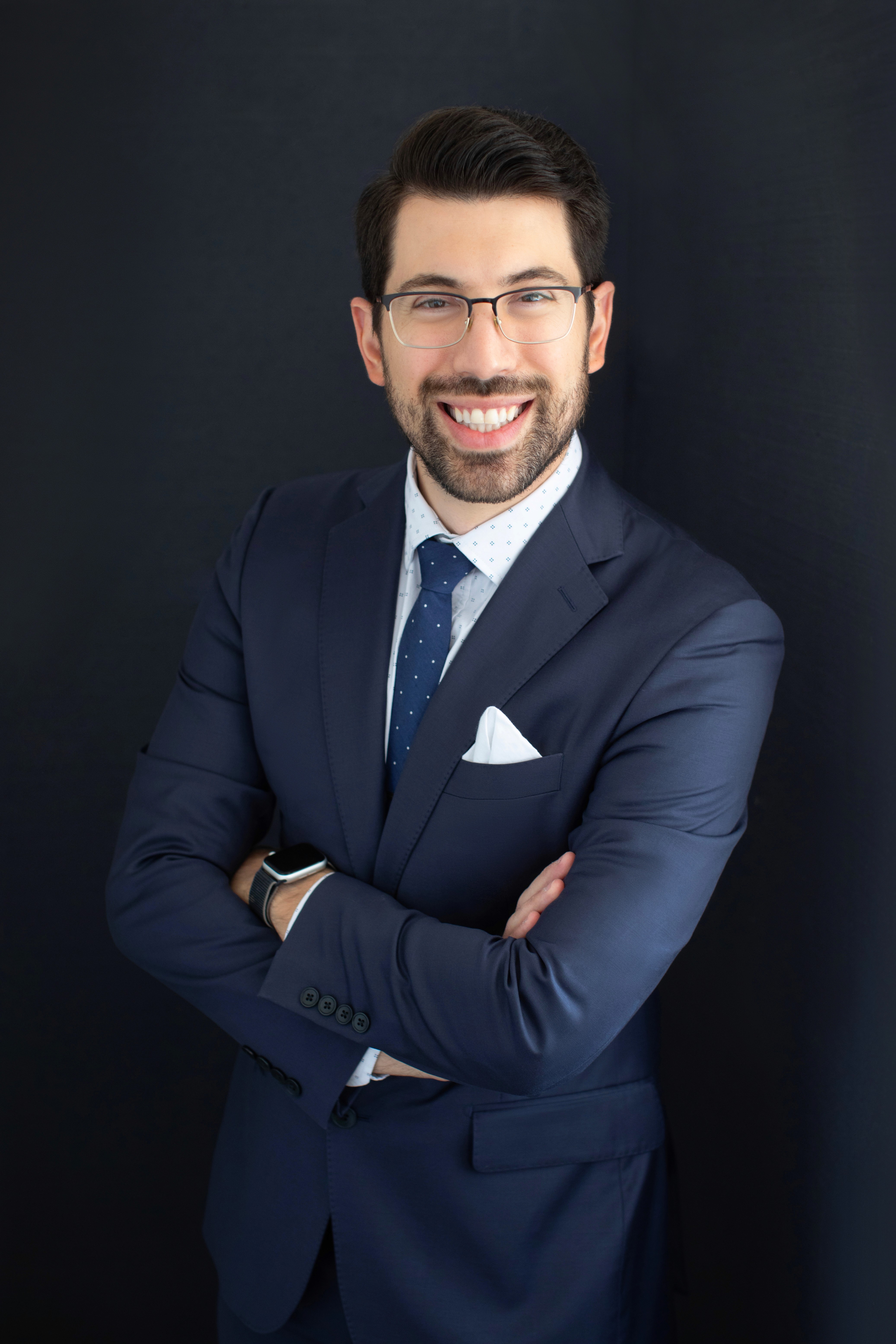

The Lawyer Who Starts Where Others Finish
Most lawyers spend their careers walking into rooms full of broken things. A collision. A contract gone wrong. A marriage ending. A will being contested. The phone rings because something has already fallen apart, and the attorney is there to help pick up the pieces.
Sal Picataggio, a partner at Orlando-based boutique immigration firm Colombo & Hurd, lives in a different world entirely.
"No one's toaster oven exploded," he says with a grin, describing the people who walk through his door. "It's, 'I have this amazing opportunity because of this job or this business opportunity, my kids can go to school here, all these cool things, and you're going to trust me to help you with that.' That's amazing."
This, to him, is the quiet secret of immigration law. While the rest of the profession diagnoses wounds, he builds launchpads. "It's one of the few areas of law that starts from such a positive place of hope and opportunity," he says. "This is someone's dream."
And yet Sal almost never ended up here at all.
Sal Picataggio's Accidental Entry Into Immigration Law
The year was 2008. Sal had just graduated from the University of Florida. The economy was in freefall. Like most of his classmates, he headed to law school hoping the storm would pass by the time he emerged on the other side. It didn't.
By the time he graduated from the University of Florida's Levin College of Law in 2011, the recession had settled in for a long stay. Jobs were scarce. Bills were not. He and his now-wife had one simple imperative: one of them needed to land work, and fast.
Immigration law wasn't the plan. Intellectual property was the plan. But in his final semester, Sal had filled a hole in his schedule with a one-credit business immigration elective taught on a Friday morning by a visiting adjunct from the Orlando area. It seemed harmless enough, just another box to check.
Then one of his classmates landed a job with the same adjunct professor. A lead opened up. Sal took the meeting.
"I kind of took the meeting thinking, like, oh, maybe it's just someone I knew," he recalls. "Did I really have this desire at the time for immigration? Not so much."
His very first file told him something he didn't yet know about himself. It was an EB-5 regional center amendment, a dense, technical piece of investor immigration work that most new attorneys never go near. Instead of running from the complexity, he leaned in.
"I jumped right into business immigration and investment immigration right away," he says. "Which might be a little bit different than a lot of other people who may start by doing asylum cases or deportation or family-based cases. I jumped right into regional centers of all things. And that's kind of where I've sat basically to this day."
Why Sal Picataggio Stayed in Immigration Law
Sal will be the first to admit he is not a world traveler. He doesn't speak a string of foreign languages. He doesn't collect passport stamps. So what kept a reluctant intellectual property hopeful anchored in a practice area he'd stumbled into?
People. Specifically, people in motion.
"I just do enjoy people and I enjoy learning about people and what they're doing, what they're up to," he says. "And this is such a cool way to do that because it's so many different cultures and people coming from all over with these dreams and these goals. It just became this very fulfilling thing in that way. And also, it turned out I was pretty good at it, which was a big plus."
The clients are not coming to him with grievances, he points out again and again. They are coming with ambition. They have made what he calls "an unbelievably massive decision" to uproot their lives and place their future in a stranger's hands. "They're coming to us with that dream and that hope and that ambition," he says, "and they're trusting us with that."
That trust is the thing he refuses to take lightly, even as he laughs about the LEGO jazz drum set on display in his office. "Does someone like me take myself that seriously as I look around with all my nonsense in my office?" he says. "I mean, that's the thing. We're people too, and we are fully appreciative of that trust."
From EB-5 Regional Centers to the NIW Pivot: The Colombo & Hurd Playbook
Sal's career at Colombo & Hurd has tracked the evolution of American business immigration itself. The first half of his practice revolved around EB-5, E-2 treaty investors, and L-1 intracompany transfers. Then, around 2017 and 2018, a policy shift changed the landscape.
"The Dhanasar decision kind of changed things," he says, referring to the 2016 AAO decision that reshaped the National Interest Waiver framework. "The NIW kind of became the thing as I was transitioning my own employment during that time. I saw this opportunity to learn more about that type of case and get in as that was still kind of growing. It wasn't like the initial Wild West period where everyone was just getting an NIW for pretty vague reasons. The pendulum had already swung a little bit back to a little bit more scrutiny, but it was still early on."
Today, the NIW makes up the majority of his caseload, though he has also dove back into the investment visa work that first drew him in. The common thread, he says, is the kind of client these self-petition categories attract.
"You're working with someone who has that individual dream and that professional background, and they're going to develop this project and plan to benefit the United States," he explains. "It's someone who is so dedicated to it and so committed to it, and they have an interesting story to tell. That's kind of why I like doing the self-petitioner stuff."
Pathways for Dreamers: Sal Picataggio's 30,000-Foot View
Ask Sal what an ambitious founder or professional abroad should actually do if they want to build something in the United States, and you get a thoughtful, layered answer. There is no single right door. There is only the right door for a specific person.
The National Interest Waiver (EB-2 NIW). For advanced-degree professionals with a proposed endeavor that stands to benefit the country. It leads straight to a green card, which is why, as Sal notes, it dominates the conversation for many first-time consultations.
The O-1. For those who need speed and can secure a U.S. agent or sponsor. Not permanent, but fast.
The E-2 Treaty Investor. Sal's practical favorite for a fast-moving entrepreneur. "A substantial commitment of funds," he explains. "$100,000 is often a pretty good threshold where if you're at or above that, officers will have fewer concerns and questions." Available only to citizens of qualifying treaty countries, the E-2 is renewable indefinitely, allowing someone to build an American business for decades without ever touching the green card line.
The EB-5 Immigrant Investor Program. The permanent-residency play. Current thresholds sit at $800,000 in targeted areas and $1.05 million elsewhere, with a firm requirement of ten full-time jobs created per investment. Most investors go the regional center route, pooling capital into real estate, hospitality, and development projects. "Here in Orlando, the Orlando City Stadium, where the MLS team plays, was not built with public taxpayer money," Sal says. "But it was built with a good chunk of foreign investment through EB-5."
The L-1. For founders already running businesses abroad who want to expand stateside through an intracompany transfer.
The real work, he emphasizes, is not matching someone to a visa. It is matching the visa to their life. "What are your goals? What are your needs? What are your plans? Finding the one that makes the most sense for them. Is it going to be an exact ten out of ten, every box checked, exactly what they want? That's maybe not super realistic. But are we going to get someone to do the right thing for them? That's the goal."
The "But My Friend" Problem: A Warning From Sal Picataggio
Ask Sal to name the most common misconception he sees among prospective immigrants, and he gives it a nickname.
"The 'but my friend' phenomenon," he says. "But my friend did this a couple years ago. And why am I not doing what they did?"
He is too gracious to call it an error. He prefers to call it a trap. Immigration policy doesn't hold still long enough for anyone's friend to be a reliable guide. The NIW backlog has grown substantially over the last year. Fewer I-140 decisions are being issued. Adjudication trends shift quietly, without announcements.
"Someone who is looking at what their friend did in 2023 or 2024 versus what someone might expect today is going to be different," he says. "Being too committed to what has been done in the past, while there is a lot to be learned from what has been done previously, being too stuck to that could put you in a rough position. And I don't want people to make that mistake."
It is also, he admits with a laugh, a version of a problem he watches from the other side. Former clients sometimes refer friends who then ask him why their cases aren't being built the way someone else's was a year earlier. The answer is always the same: because the landscape moved.
Adaptability as a Core Discipline at Colombo & Hurd
If there is a single professional virtue Sal comes back to, it is adaptability. Not as a slogan, but as a daily practice.
"Being too married to things that work all the time, you need to be able to be flexible and adaptive," he says. "What I'd be doing today is not necessarily what I was doing a year ago. There are just these nuances that change over time. We take advantage of what we can learn from changes and trends in adjudication."
Filing at the volume Colombo & Hurd does gives his team an early read on those trends. When argument structures stop landing, or when a particular type of evidence starts drawing more RFEs, they see it before it hits the broader bar. That intelligence shapes the next case, and the one after that.
Over the last year and a half of policy volatility, he says, the discipline has sharpened rather than changed. "Being diligent, doing the research, really diving into what immigration offices are saying in decisions or RFEs. Keeping in mind what the plain language of regulations say. Being very diligent about developing a strong case and hitting different options and abilities to put people in the best position."
He builds every case now with the assumption that something will shift after filing. The case has to survive the unknown. "Patience is a virtue, and adaptability is a virtue," he says. "That ability to work with a client and partner with them, to know that we are in their corner based on what we know today, but also to adapt in the future, is very important to us."
Sal Picataggio on AI in Immigration Law: Cautiously Curious
Ask most attorneys about AI and you get either a sales pitch or a sermon. Sal gives you neither. He gives you the measured take of a practitioner who has seen growing pains before.
He sees clients using AI as a research companion the same way they once used Google, and he understands the impulse. "It's sometimes a feeling of lack of control when you're trusting that USCIS will eventually make the right decision and try to figure out what's going on."
For his own practice, his posture is more cautious than evangelical. He is wary of hallucinated citations. He is not ready to hand the wheel over. But he sees clear value in AI as a second set of eyes: analyzing source-of-funds documentation, tracing fund flows, reformatting content he already trusts, catching what a tired human might miss.
"When we have the information that we're happy with, and we need to go from one form of that information to another, I'm giving it the content I know it's supposed to have and it's just more modifying it. That's one thing."
He is, he admits, a little surprised by his own restraint. "It's funny, I never thought I would be the one who isn't right up to the edge with technology stuff. But it's something that I'm excited to see, even if I'm not always messing with it on a day-to-day basis."
That caution is telling. Sal is not anti-technology. He is simply unwilling to let a tool interpose itself between his clients' dreams and the standard of care they deserve.
The Professional Stress Haver: Why Sal Picataggio Still Loves the Work
Near the end of our conversation, Sal offers a line that could be the thesis of his entire career.
"You're a professional stress haver," he says, describing what law school really trains a person to become. "And it's channeling that into those moments where you have that victory. You have that approval and that person is able to get to that next step in their life. That's just awesome."
For all his self-deprecation, for all the LEGOs and the old marching-band stories, this is a lawyer who has thought carefully about what he does and why it matters. When approvals come through, he celebrates with his clients. When RFEs arrive, he is as frustrated as they are. "I want this thing to be approved too," he says. "I work really hard on this. And we've worked together, we've learned about you and your family, and we like you. We want you to be successful."
That is the closest thing Sal Picataggio will give you to a mission statement. Immigration law, done right, is not transactional. It is relational. It is someone trusting you with the most consequential decision of their life, and you returning that trust with diligence, humanity, and the refusal to treat the work as a template.
He didn't plan to spend his career doing this. He is very glad he did.
"This is someone's dream," he says again, almost to himself. "And that's why we care about this so much."




Bob Webber
SEP 16, 2025
Charles Kuck
SEP 15, 2025

Christa Byker
SEP 11, 2025