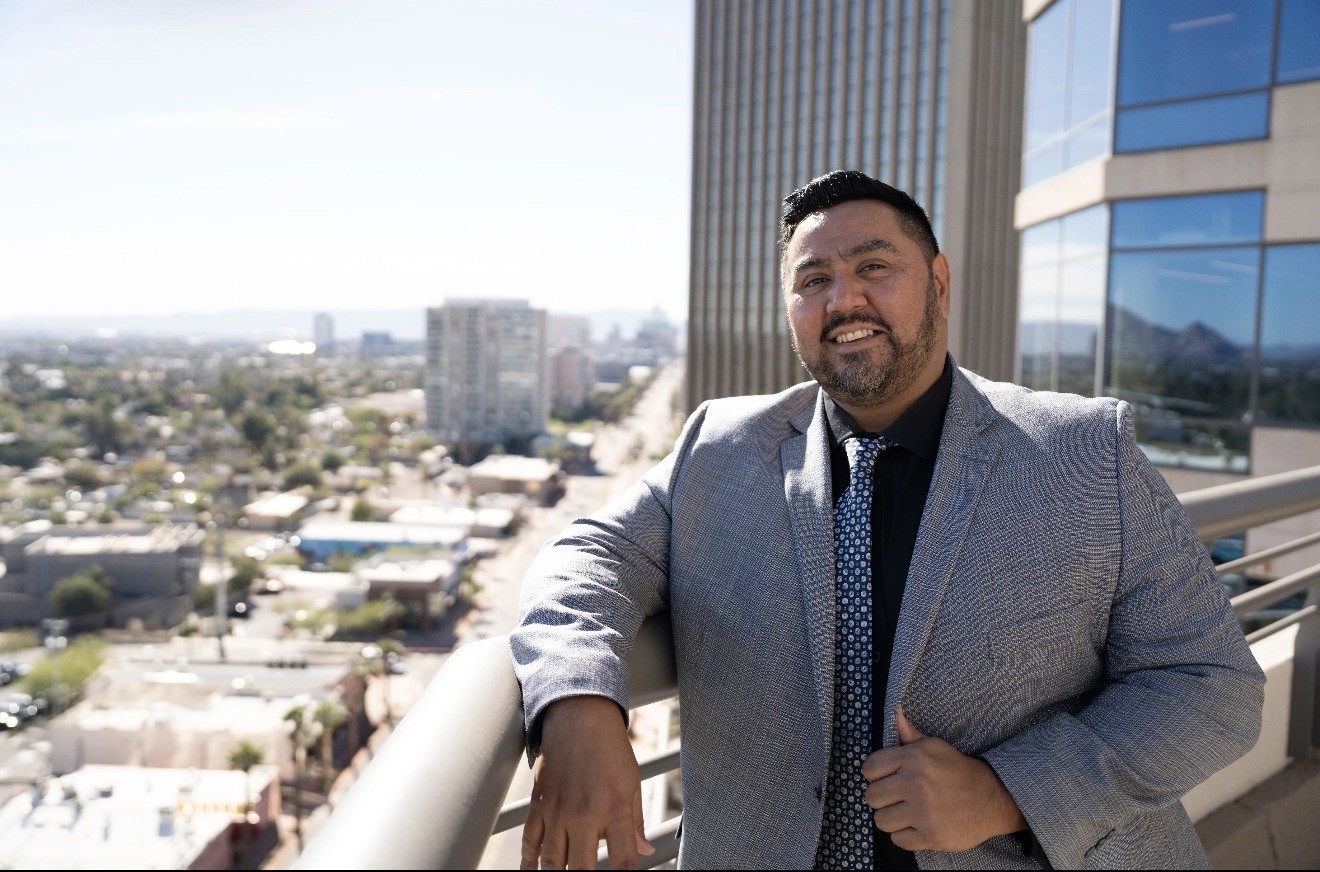

He showed up early for baseball practice one morning at Cochise College, a few miles outside Douglas, Arizona, hoping to squeeze in some extra swings before his teammates arrived. Instead, he found people hiding in the dugout. Men and women who had just crossed the desert, crouched low in the shadows of a college baseball field, trying to stay invisible until Border Patrol moved on.
Ray Ybarra Maldonado was a college athlete then, not a lawyer. But standing on that dusty Arizona diamond, he started doing the math that would redirect his entire life. "Literally people risking their life just to come here, and all I care about is this game," he remembers thinking. "Maybe I should go to school and see how I can come back and help out in that area."
More than two decades later, he runs a 50-person Phoenix law firm that has built its reputation defending that same community. This is how he got there.
Ray Ybarra Maldonado's Roots: the Borderlands of Douglas, Arizona
Ray was born in Douglas, a small border town in southern Arizona. His mother was born on the Mexican side, in a town a few miles south. Growing up, immigration was never an abstract policy debate on a cable news screen; it was the sound of Border Patrol vehicles passing his house and the reality of neighbors vanishing into federal custody.
"Really not being involved in immigration, or not caring about immigration, it really wasn't an option for me," he says. He remembers coming home from road games during his baseball years at Cochise College and seeing up to a hundred people stopped at a single Border Patrol checkpoint. He remembers reading about migrants who died in the desert heat just a few miles from where he was practicing his swing.
Something in him decided he could not look away.
Why Ray Ybarra Maldonado "Hated" Stanford Law but Couldn't Walk Away
He went back to Arizona State University for his undergraduate degree in religious studies, then went all in on law school applications and landed at Stanford. And then he hated it.
"The most miserable, horrible place in the world," is how he describes his first stretch there. Instead of grinding through three straight years, he took the unusual step of walking away for two. He came back to Arizona, joined the ACLU, and launched one of the more unconventional projects of his early career: following armed vigilantes through the desert with a video camera.
It was 2005 and 2006. Self-appointed border militias were rolling into southern Arizona with the stated goal of doing what they claimed the federal government would not. "They were literally saying, the government's not doing their job, so we the people are going to go down there and we're going to stop immigration," Ray recalls. He built a program to trail those groups through the desert, documenting their movements on tape. The purpose was blunt: to make sure nobody got beaten or shot.
He spent two years on that project, went back to finish his third year at Stanford, and returned to Arizona still unconvinced that a courtroom was where he belonged.
The Protest That Became a Law Firm
At that point, Ray did not actually want to be a practicing attorney. He appreciated the law degree. But he was drawn to community organizing, civil disobedience, and agitation, not billable hours. He was living back in Douglas, working at a migrant shelter on the Mexican side of the border, and driving up to Phoenix for protests.
At one of those protests, he fell in love.
He moved to Phoenix, married the woman he met in the streets, and together they started a nonprofit focused on immigrant and worker rights. It was during this activist chapter that he started noticing something that shook him. The attorneys who claimed to serve his community were, in many cases, the ones hurting it the most.
"A lot of the attorneys that claimed to be focusing and helping the community were just throwing people over, and really for the most part not providing quality services," he says. "Being more about themselves than they were about helping people."
That was the moment the Stanford degree stopped being a credential on a shelf. He took the bar. He became a lawyer, not out of ambition, but out of something closer to refusal. The community deserved better, and he had a license that could force the issue.
A $1,500 Check and a Costco Laptop: How One of Phoenix's Top Immigration Firms Really Started
Ray's first step as a practicing attorney was to work under an experienced immigration lawyer for free. "He didn't have any money to pay me. I said, that's fine, you just teach me. Because in law school you learn theory and philosophy. You don't learn how to actually be a lawyer." From there he went to the Cochise County public defender's office, then to the federal public defender in Tucson.
When he and his wife had their first child, he asked to transfer to Phoenix. His boss said no. So Ray took a job with an attorney already practicing in the city. That lasted exactly two weeks. He realized his new employer was charging clients five thousand dollars for work that, in his view, barely existed. "I can't do this," he told his wife.
Nobody else was hiring. His former office had already thrown him a goodbye party. So he and his wife made a decision that sounds almost reckless in hindsight.
They started their own firm.
"We literally just put on Facebook, criminal immigration law firm," Ray remembers. Because they were known for showing up in the streets, the community started sending people their way. His very first U visa client paid him fifteen hundred dollars. He can still see her hand shaking as she handed over the cash. His was shaking too.
"I didn't even deposit that check," he says. "I cashed it and went and bought a laptop at Costco so I could fill out the U visa application."
He and his wife were living at his in-laws' house. They had no money. He was billing twenty thousand dollars of work into five-thousand-dollar cases because that was the only way to earn the community's trust. One client would come in, respect the work, and send five more.
That was fourteen years ago.
Fourteen Years Later: A Top-Floor Office on Central Avenue
Today, Ray's firm occupies the entire top floor of a building on Central Avenue in Phoenix and employs around 50 people. It has grown 30 percent or more every single year, including through the pandemic. The firm was recently named to the Sun Devil 100, the Arizona State University alumni ranking of fastest-growing, alumni-led businesses.
"It's just a dream come true," Ray says. And then, almost in the same breath, he gets back to the work: "I wake up every morning. I see what's in the paper. What's ICE doing today that I'm pissed off about? Okay, let's find the case. Let's go do something about it."
The Firm's Mission: Family, Humanitarian Visas, and Deportation Defense
The firm's focus is deliberate. Ray's team handles family immigration, humanitarian visas, and deportation defense. They do not currently take business immigration cases, though Ray says he would like to add that practice once he finds the right attorney to lead it.
The reason for the narrow lane is strategic, and it is personal. "We really saw that lack of attention toward quality legal services for our community," he says. A lot of money had been spent marketing to Arizona's Latino community, but the quality of the work was, in his words, "absolutely terrible." So his firm's stated mission, from day one, was to be the best possible firm for that community. Growth, he figured, would follow. And it has.
The New Reality: Why Ray Ybarra Maldonado's Firm Is Filing Habeas Corpus Petitions in Federal Court
Ask Ray what has actually changed in his practice over the last year and a half, and his answer is blunt and specific.
"The biggest change we've seen this last year is our need to go to federal court. We're filing habeas corpus petitions pretty regularly. We're probably at over 20 that we've done now, even in the last two months."
For decades, immigration lawyers could resolve most matters within the Executive Office for Immigration Review and the Board of Immigration Appeals. Ray's team is now routinely reaching past that system into federal district court. It is a meaningful shift in how immigration defense works, and one that firms without the appetite or the infrastructure for federal litigation will struggle to keep up with.
The One Policy Ray Ybarra Maldonado Would Eliminate Tomorrow
Asked what single piece of immigration policy he would erase if he could, Ray does not hesitate. The permanent bar. The provision that prevents many people who once lived in the United States without status, left, and returned from adjusting status through a U.S. citizen spouse or adult child.
"There's so many millions of people who are married to a citizen or have kids that are over 21 that they could become residents within less than a year. But this ridiculously illogical law says if you were living here longer than a year, left, and then came back, you're barred and have to go back out of the country for 10 years."
In the bigger picture, Ray would go further. "Get rid of the statute and let the market decide who's going to stay and work and who's not going to stay and work."
The Biggest Mistake Immigrants Make, According to Ray Ybarra Maldonado
After years of working with people at the worst moment of their lives, Ray says the most damaging mistake he sees is not legal. It is psychological. It is fear.
He describes a pattern. Someone is scheduled for a court appearance. They convince themselves that showing up means getting deported that day. So they skip. That one decision triggers a removal order. Later in life, they marry a U.S. citizen or otherwise become eligible to adjust status, but the old removal order has now slammed a door shut that did not need to close.
"Letting fear win instead of life," is how Ray describes it. He has had clients tell him they used to take walks with their families every night and have stopped doing so because ICE might be in the neighborhood. "It's just this horrible thing that people are forced to live in fear, as opposed to just realizing this one life we get, we might as well live it. If the government does something, we'll deal with it. But until then, we're just going to keep living."
His advice is not to ignore the risk. It is to refuse to let the risk consume the hours, days, and years of life that are still here to be lived. "Be prepared, have a plan, have an attorney. But don't let it dominate your life."
"You're Not a Client, You're Family": The Philosophy That Defines the Firm
When a new person signs up with Ray's firm, the first thing he tells them is not about paperwork. It is about identity.
"You're not a client. You're a family member," he says. "I'm very selective of who I hang around with. And even when you come on my team, whether we're doing an I-130, whether we're doing a VAWA, whatever it is, I need you to have that positive energy, because I need that positive energy to do the work I'm about to do for you."
He asks his clients to hand him their fear. Literally. "Take that fear and anxiety, put it on our shoulders. You go about and live your life. Continue to live, continue to be happy, create memories, and let us focus on the legal work."
It is a reframing of the attorney-client relationship that would feel theatrical coming from almost any other attorney. Coming from Ray, after an hour spent tracing his path from Douglas to Phoenix, it just sounds like the job description.
Miguel's Story: Why Ray Ybarra Maldonado Still Flashes Back to One Client
Asked for a success story, Ray names Miguel.
The firm first met Miguel in jail, during the notorious era of Maricopa County Sheriff Joe Arpaio. Miguel had been arrested and charged with a felony. Ray's team took the case to trial and won a not guilty verdict on every count. From there Miguel moved into immigration court, where he won cancellation of removal after multiple appeals. Today, Miguel is a lawful permanent resident on the path to U.S. citizenship.
"That's someone that we met at their lowest point, facing felony allegations, located inside of jail," Ray says. "And every time I see any video on social media of someone being taken into custody, someone being detained, his image comes back to me. Like, hey, even though it looks really bad right now, we might be able to help that person. We might be able to change that person's life."
Ray Ybarra Maldonado's Message: Find Your Calling, Then Go All In
If there is a single thread running through Ray's journey from border baseball player to federal court litigator, it is the belief that a well-lived life begins with an honest conversation with yourself.
"Spend time exploring who you are, what drives you, what motivates you, and what makes you happy," he says. "And when you identify that, that's when you go all in."
He credits travel, exposure to different cultures, and the willingness to sit with discomfort as the tools that help a person find that calling. And once it's found, the rest, he says, is simple.
"Don't be persuaded or dissuaded by anybody. If you feel like doing it, go out there and get it done."
For Ray Ybarra Maldonado, the boy who once watched people hide in a dugout at Cochise College, that has been the whole point all along.





Bob Webber
SEP 16, 2025
Charles Kuck
SEP 15, 2025

Christa Byker
SEP 11, 2025