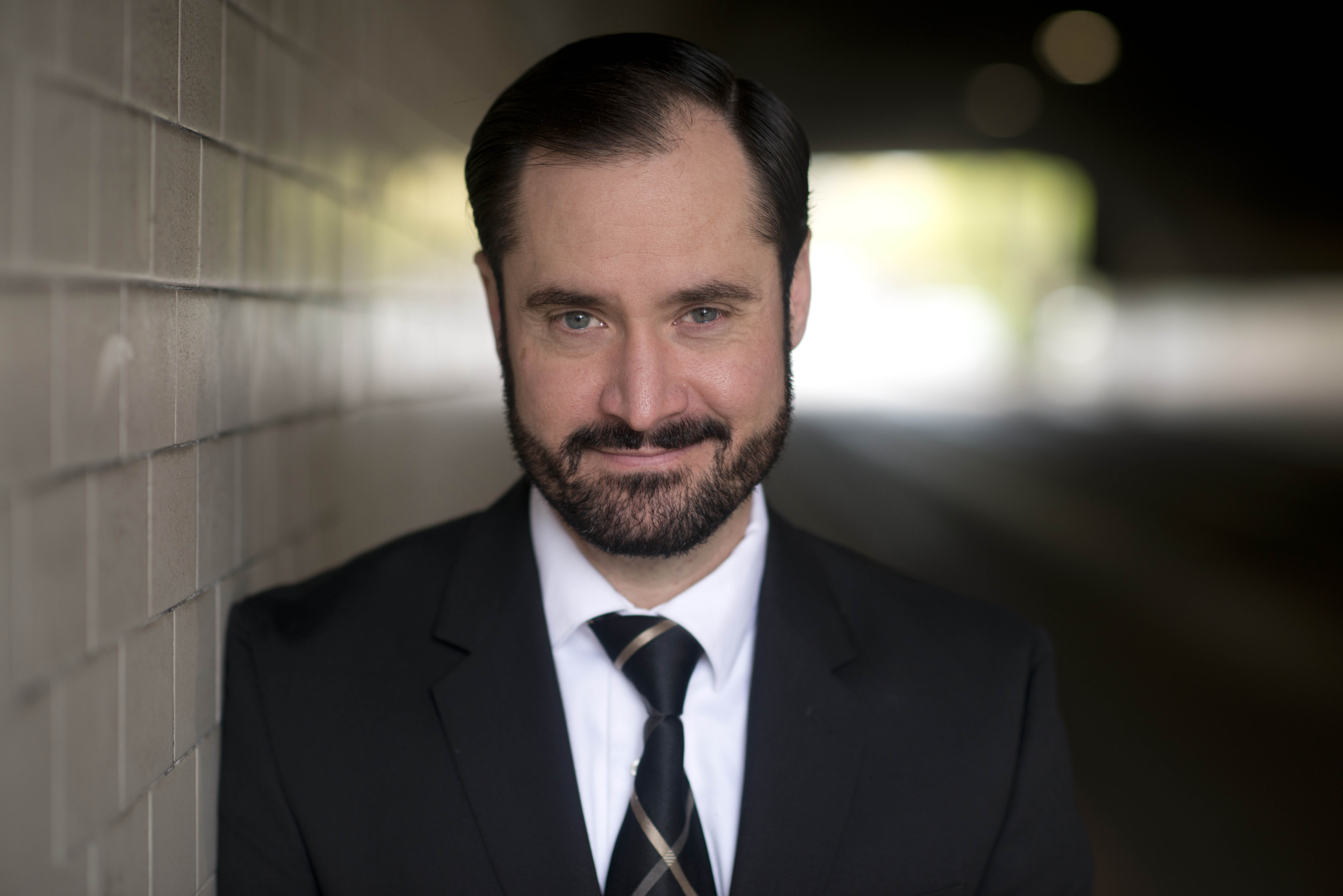

The U.S. federal government, Brian Clark believes, is a big lumbering behemoth. It treats people like numbers, and he enjoys pushing back against it.
This perspective didn’t come from a lifetime in courtrooms or a family legacy of legal advocacy. It emerged from an unconventional journey that wound through the countercultural worlds of independent music and art, late-night bartending shifts, driving an Uber around Los Angeles, and a study abroad term in Spain that would ultimately shape his legal career path. Now, as a U.S. immigration attorney in Denver navigating what he calls “one of the most chaotic periods in recent memory,” Clark has spent more than half a dozen years engaged in courtroom deportation defense, representing asylum seekers and other noncitizens whose lives hang in the balance of an ever-shifting legal landscape.
How Brian Clark Found His Path to Immigration Law
Majoring in Art as an undergrad in the late 1990s, Clark came to the law as a second career in his early thirties, enrolling in law school in 2012. Before that, he spent his twenties doing what former Art majors often do: travelling and “messing around with creative pursuits” that were, as he puts it, “predictably not a great way to make a living.” Meanwhile, he worked office jobs doing administrative assistance, taught English overseas, managed an apartment building, and did technical writing at a factory. In his early thirties, he decided that something had to change.
Law school came in the form of an online program that Clark could complete while still working. As a law student, he bartended and drove for Uber in the gridlock of Los Angeles to make ends meet. By 2016, just after graduating from law school, Clark had passed the California Bar Examination on his first attempt. Once sworn in as an attorney, he started his legal practice with plaintiff-side employment law, then dabbled in estate planning and personal injury, before moving from California to Colorado in late 2017.
Initially limited to federal legal practice in Colorado as an out-of-state lawyer, Clark parlayed his Spanish language abilities, previously picked up from studying and teaching in Spain, into a federal deportation defense skillset. In March 2018, a small Denver immigration firm hired him to represent its many noncitizen clients from Colorado’s Spanish-speaking Latino community.
“I’m not much of a partisan ideologue on the issue of immigration, but I spent part of my twenties sticking up for cultural scapegoats and pariahs in indie music and weirdo art scenes, so it made sense to me to work as an advocate for a currently scapegoated group like immigrants,” Clark explains. He dove into the work. “It was early in the first Trump administration when I started in immigration law, and I spent most of my time in court,” Clark recalls. “Dozens and dozens of hearings. Master calendar hearings, bond hearings, individual merits hearings, and appearances at the Colorado branch of U.S. Citizenship and Immigration Services.” During the first Trump Administration, it seemed like every noncitizen in the U.S. was issued a court hearing date, and Clark and other U.S. immigration attorneys stepped up to represent them before the federal immigration bureaucracy.
Success Stories from Brian Clark’s Immigration Defense Practice
Despite the U.S. immigration system’s challenges, there are victories worth celebrating. Clark has won asylum cases for clients from across the globe. He cites as one notable example the case of a noncitizen who, prior to coming to the United States, had been a member of a Central American country’s elite law enforcement agency, and who had arrested and testified against high-ranking members of MS-13; and thereafter became their target for reprisal and retribution. “The government of his country didn’t have a handle on MS-13, and they couldn’t protect him, even though he was law enforcement. He finally, after multiple attempts at relocating in his country, fled and came to the U.S.,” Clark recounts. “His story was pretty crazy. I was able to win asylum for him, so he doesn’t have to go back and face MS-13.” Despite being a decorated law enforcement officer in his home country, Clark’s client faced an uphill battle to avoid deportation from the United States back to the country where he was at risk. “That case was easier than most, but it still wasn’t a walk in the park,” Clark notes.
Removal defense cases in immigration court are never easy. As Clark puts it, “U.S. Government attorneys are typically well-educated, well-paid, and aggressive. They do not like to lose, so even seemingly straightforward cases still require a fight.” But these are the victories that make the work meaningful.
Clark also cites as noteworthy his representation of multiple women from parts of Africa where female genital mutilation remains practiced. Women who, in some cases, fled violent armed conflict zones after being raped or shot, who then traveled through Africa and Central America before reaching the United States. Some of whom then waited more than a decade for their cases to conclude before being granted asylum by a U.S. immigration judge. Clark describes such women as being “particularly sympathetic” clients, even though they tend not to be representative of how immigrants are generally perceived by many Americans who harbor hostile attitudes towards “migrants.”
The Reality of Immigration Court: Brian Clark’s Honest Assessment
Clark doesn’t sugarcoat the odds. Most people who end up in immigration court don’t have stories as compelling as a targeted elite law enforcement officer or a victim of FGM. They often have very understandable reasons for leaving their countries, but the legal standards for asylum in the United States are specific and demanding. If applicants cannot prove that they were legally “persecuted” and that the government of their country of origin acquiesced to their persecution or would “turn a blind eye to it”; and that they cannot safely relocate internally in their country to be safe from harm; and also that they were individually targeted because of an immutable characteristic about them rather than just general crime; they will likely lose. Most do. Given the multi-prong legal standard for asylum in the U.S., removal defense in immigration court has always been difficult, but under the second Trump Administration, it has only become more so.
Brian Clark on The Changes Wrought By a Second Trump Presidency
“It’s been much worse than I anticipated regarding the aggressiveness of the new Trump administration,” Clark admits. “The changes have been a lot more extreme than they were in Trump’s first term, particularly in the areas of bond and asylum law.”
For U.S. immigration attorneys, the past year has brought whiplash-inducing policy shifts. Clark describes scenarios in which a noncitizen or their American relative might walk into the office with a viable case, only to have the legal landscape shift dramatically within a week or two. The interpretation of who qualifies for what relief from deportation, or for release from detention on bond, under what circumstances, has seesawed between positions, with nationwide class action lawsuits creating further uncertainty.
This volatility is what distinguishes immigration from most other legal fields. Personal injury law, employment law, estate planning: these areas tend to change slowly and with some degree of predictability. In contrast, U.S. immigration law in recent years has fluctuated wildly with each presidential administration. Immigration attorneys face ethical duties to advise clients, yet oftentimes cannot reliably predict what the next sweeping policy shift will bring. “Most areas of the law barely move for years at a stretch,” Clark observes. “Immigration law flip-flops every time we get a new president. That’s not normal. That’s not how a legal system is supposed to function.”
But Clark’s deepest concern at the close of 2025 centers on emerging third-country Asylum Cooperative Agreements. The United States has long maintained an agreement with Canada preventing asylum seekers denied in one country from simply starting over and seeking asylum in the other. Now, however, novel Asylum Cooperative Agreements are being entered into between the United States and African and Central American nations, most notably Honduras.
The implications are wide-reaching. As Clark explains, under the U.S. government’s new interpretation of the law allowing for such third-country agreements, foreign asylum seekers in the United States—people who filed their asylum applications years ago, gathered their evidence, paid their American attorney, and prepared for their day in court—may find that on the day of their final hearing the U.S. government is asking the immigration judge to dismiss the case so that the person can be deported to a third-country that they’ve never been to, to supposedly start all over and litigate their asylum claim there. “This is not normal,” Clark explains.
Why Brian Clark Says U.S. Immigration Law Lacks Fundamental Fairness, Regardless of Trump
What troubles Clark most about U.S. immigration law runs deeper than any single policy or presidential administration. It’s structural. As he explains it, “In general terms, the American legal system contains within it two ways of resolving problems: law and equity. Back at the time of the country’s founding, these were actually two parallel court systems: courts of law, which dealt primarily with hard-and-fast rules of law and could grant monetary damages, and courts of equity, which were geared towards a more nebulous fairness of outcome, and could do things like issue injunctions. That’s a gross oversimplification, but those two basic concepts still run in tandem throughout most of American law today.” But not in U.S. immigration law, Clark argues.
“Immigration law is overwhelmingly statutory. It’s what Congress has written into law, and that’s all that matters unless an appellate court steps in to occasionally clarify something.” As Clark further explains, “immigration court cases are heard by single immigration judges. There is no jury of regular people involved with heartstrings to pull on.” And immigration judges at the trial level rarely have the latitude or the deference to consider what is fair or equitable in any given case. “They have to stick to what the law says, even if it results in obviously unfair and unjust outcomes.” And the outcomes often shock and surprise many who aren’t familiar with the system.
Clark sees this dearth of equitable principles in U.S. immigration law as the fundamental unfairness that makes removal defense unique in the American legal system. “Equitable concepts rarely come up in removal defense. There are rare exceptions here and there, but most of the time, if a noncitizen’s moral character, or mental state, or their actions in life come up, it’s when the government is trying to use someone’s criminal history against them.”
Fairness in outcome is tangential. “Everyone involved in the system is aware of the fact that the system isn’t set up with fairness in mind per se, and they are, to whatever extent, just jaded to that fact,” Clark says, “and yet the system churns on. In the end, none of the equities in a person’s case usually matter. The black letter law is just applied rotely.” The outcomes can be harsh and can defy common sense.
Consider children. In criminal or civil matters, minors can invoke the defense that they lacked the mental capacity to understand their actions, or shouldn’t be held legally accountable for them due to their young age. This principle generally doesn’t apply in much of U.S. immigration law.
“If you’re born on the wrong side of an imaginary line in the middle of the desert just south of Texas, and your parents took you across the border into the U.S. when you were six months old, the fact that you had nothing to do with that decision because you were a baby doesn’t matter,” Clark explains. “Even if you grew up in Texas speaking English, you went to high school in Texas, you work and own a home in Texas, you’re married to a Texan, you have U.S. citizen kids in Texas, and you’ve never been to Mexico and don’t speak Spanish, none of that usually matters. Even if you’re ‘culturally American’ to the core, with respect to how your removal defense case is adjudicated, what matters is what it says on your birth certificate and whether or not you can raise a legal defense to removal.”
Clark says that he has represented numerous noncitizens who were born abroad but grew up in America and now face difficult odds in immigration court. “They might have been eligible for DACA but missed an application deadline, or made a poor decision as a teen and got a DUI, or whatever it might be, and now they’re in court trying to argue why they should be allowed to stay in the only country they’ve ever called home. Something that the rest of us just take for granted.” And it’s not easy.
“Part of what’s unfair about it all is that people outside the system don’t get how it works. People think they can tell their sob story to the judge or whatever, and they don’t realize that the point of the system is not to arrive at fairness in each individual person’s case. It’s to just apply the laws that Congress wrote decades ago, as interpreted and enforced by the current administration, whether the outcome is fair or not, and whether it even makes any sense or not.” This, Clark argues, causes the U.S. immigration court system to routinely arrive at unjust outcomes, which he sees as counter to the foundational idea of what a court system is supposed to do in the first place.
Looking Ahead: Brian Clark on the Future of Immigration Practice and Artificial Intelligence
At the end of 2025, not only is the legal landscape of U.S. immigration practice rapidly shifting under the current presidential administration, so too is the technological landscape. When asked about artificial intelligence in legal practice, Clark offers a measured assessment. He sees clear potential for efficiency gains from AI in the form of repetitive form completion, error checking, and possibly legal research and drafting. But as of late 2025, he considers reliance on AI for legal research and writing to be very risky.
The hallucination problem remains Clark’s primary concern. He’s aware of the “horror stories” of attorneys filing documents that they never properly reviewed because an AI’s output looked convincing enough to bypass scrutiny, with disastrous consequences. However, he expects this hurdle will be overcome soon, given AI’s rapid improvement, and he recognizes that tools capable of automating paralegal work could help smaller firms and solo practitioners, which would be a boon to attorneys like him.
Still, Clark worries about the broader implications of AI. “I’m always concerned about giving too much weight to assessments made by AI or giving AI decision-making responsibilities that need to be checked by humans,” he says. His particular concern is what may begin to happen when AI gets deployed on the government side of immigration processing by agencies like the U.S. Citizenship and Immigration Services. Without careful human oversight, flawed AI determinations could go unchallenged. In other words, noncitizens’ cases may be denied by machines.
Clark compares the current state of AI technology to spell check: great at catching obvious errors, but not a reliable replacement for actually doing the research and putting in the work required to present a client’s case. As he explains, “AI is no substitute for a competent human attorney who understands the law and how it interfaces with the system and the individualized facts of the client’s case.”
Going into 2026, Clark carries with him a clear-eyed understanding of both the system’s shortcomings and his own purpose within it. The federal government may be a behemoth— unfeeling and intimidating—but that’s precisely why pushing back matters. Every asylum case won, every family kept together, every individual treated as more than a number represents a small but meaningful victory against bureaucratic indifference. For now, Brian Clark continues doing what he has done since 2018: representing people whose futures depend on navigating one of the most volatile corners of American law. The rules may keep changing. The chaos may persist. But the work goes on.
Brian Clark is a U.S. immigration attorney based in Denver, Colorado, specializing in removal defense, including asylum, withholding of removal, and cancellation of removal cases. He also serves in an “of counsel” capacity for a Denver-area immigration law firm.




Bob Webber
SEP 16, 2025

Charles Kuck
SEP 15, 2025

Christa Byker
SEP 11, 2025