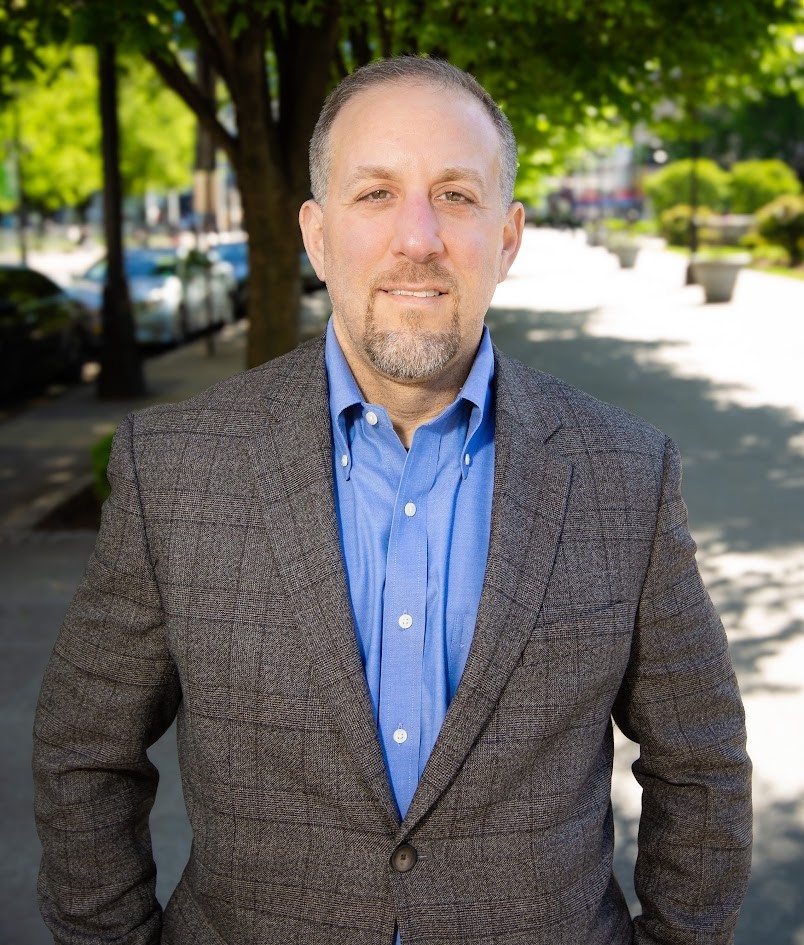

The first time Harlan York walked into a national immigration law conference, 3,000 attorneys had gathered in Orlando. It was the mid-1990s, and York, then a neophyte, did what most people his age did at the time. He listened.
That week, in the dugout of the Kansas City Royals spring training stadium, surrounded by what he describes as "all of the big stars in immigration law back then," he played softball with the top attorneys in the United States. But the moment that shaped his next three decades did not happen on the diamond. It happened later that week, when he wandered into a session almost no one else attended.
"One lawyer put on a seminar on marketing and 30 people showed up," York recalls. "30 out of 3,000."
He was one of them.
That single decision, to walk into the room most people skipped, became a kind of organizing principle for the practice he would eventually build in Newark, New Jersey.
Today, Harlan York & Associates manages a roster of cases so wide that York keeps an unofficial map in the office tracking the countries his clients have come from. Family work. Deportation defense. Detention. Asylum. Victims of violence. Professional visas. Outstanding researchers. National interest waivers. Investment-based filings. "Within the domain of immigration law, there's very little we haven't done. We have had an influence on the lives of thousands of people. It’s rewarding, every day." he says.
But scope is not really what makes him distinctive. What makes him stand out is how he thinks.
How Harlan York Found Immigration Law
York knew he was going to law school from an early age. Getting there was never the question. The question was what he would do once he arrived.
At Tulane Law from 1991 to 1994, he watched class after class fail to grab him. Trusts and estates. Property. Civil procedure. "How in the world could I make a career out of this stuff?" he remembers thinking. Intellectual property held some appeal, but nothing locked in.
Then came a second-year night course in immigration law, taught by an adjunct named Larry Fabacher, who practiced downtown in New Orleans. Within two weeks, York knew. He approached the professor after class one evening, said he liked the material, and asked if he could learn more.
The appeal of helping immigrants resonated deeply with York, whose great- grandparents arrived at Ellis Island with nothing but rags in their pockets.
Without hesitation, Fabacher invited York to his office. They spent an hour talking. Somewhere in that conversation, the law student mentioned he was fluent in Spanish. "That's going to help you a lot," the older lawyer told him.
"And you know," York muses, "one thing led to another and here I am."
Why Harlan York Studied Marketing While Other Attorneys Studied Law
Most lawyers, York points out, walk into the profession with a suit, a briefcase, and a focus on the technical work. That is what is expected. That is what you are taught. But early in his career, he developed a strong interest in something most attorneys ignored. The business itself.
He started attending conferences in addition to continuing legal education seminars. Marketing sessions on the early internet. Talks by Gary Vaynerchuk, Seth Godin, Rand Fishkin, names that would later become household brands but were just emerging voices when York first listened to them.
He remembers a Godin event where, during a break, attendees went around announcing where they came from. New media. Communications. Tech. When York declared he was an attorney, the room went silent.
"Everyone just looked at me," he recalls. "What are you doing here?"
His answer was obvious: “I am trying to figure out how to help more people.”
That curiosity had practical consequences. Around the time smartphones were just becoming a thing, he stood in front of a representative from one of the dominant legal marketing companies and pointed out that their websites were not mobile friendly. The response?
"The jury's still out on the phones."
"This is like 2007," York remembers. "I'm staring at the guy. You don't think these things are going to be attached to us?"
He was right. He was almost always right, early. Not because he was a futurist, but because he paid attention to fields outside his own.
"The marketing stuff was just fun for me. It always was. It never felt like work. Learning the law was the challenge. How to try cases, which I did successfully for 15 years, was the part that was more like work. But the business development side was interesting, and I could spend 100 hours a week on it without feeling stressed.”
Inside Harlan York & Associates: How the Newark Firm Is Built
York runs his practice out of a single office in Newark. Three outstanding lawyers there with him, each with 20 years' experience, plus two of counsel based in Charlotte and near Philadelphia, five paralegals, three legal assistants, a billing coordinator, an office manager, a receptionist, and a steady group of law student interns rotating through. He maintains relationships with top criminal defense attorneys for crimmigration work, plus a smaller bench for personal injury, divorce, and labor matters when clients need them.
When asked about volume, he replies that his firm starts new cases every day, from all over the United States and overseas. But he turns down a lot.
At 56, he is past the point of wanting to scale just to scale.
"I grew it to where I wanted to be," he remarks. "I didn't have aspirations to be lost in fragments. Plus, we see a ton of folks who simply need to hear that they should not be hiring a lawyer, because they're not eligible for an immigration application.”
His concern, York explains, has always been that growth comes at the cost of quality. He hears too many stories from clients, who came from other firms, disappointed: "We never met with a lawyer. We only worked with an assistant." That is not the kind of practice he wants to run. He still answers emails personally seven days a week and collaborates on case strategies with his team, regularly.
In 2010, when York rebuilt the firm, it was just him, two lawyers, and one assistant. He grew it deliberately to its current size. "At some point, I felt like I knew when to say when."
"Help Me, Obi-Wan": The Cases Other Firms Won't Take
A reputation follows Harlan York & Associates around. Clients arrive, proclaiming, "you are the only ones who'll take my case" or "you're my last resort." York has heard variations on that line for his entire career.
He references St. Jude, the patron saint of lost causes. He quotes the desperate "help me, Obi-Wan Kenobi" plea from Star Wars. He smiles momentarily, but his expression becomes serious when talking about the battles of immigration law. As certain immigration sub-specialties have become so esoteric and time consuming that lawyers stopped offering them, the work funnels to firms willing to absorb the complexity.
"I've felt that way throughout my career," he states, “like there’s not many immigration attorneys who get tasked with being the final word.”
The Biggest Mistake Immigrants Make, According to Harlan York
Ask York what error he sees most often, and his answer is immediate. It is not about paperwork. It is about who immigrants trust at the start of their journey.
"The first mistake they make is they go to somebody recommended to them by someone in their community, who is supposed to be reliable," he notes. "Often that person isn't even a lawyer. Or if they are an attorney, they're not particularly ethical."
These people, often called notarios in Spanish-speaking communities, sign immigrants up for fraudulent asylum filings, sham marriage cases, fake VAWA applications, anything the law allows them to exploit. "Every functional area of immigration law has been drained. Nothing is left out."
What has gotten worse in recent years is the sophistication of fraud. York has had clients come into his office who paid upwards of $75,000, duped into staged video hearings before ersatz judges, complete with official-looking paperwork. The same video conferencing technology that has made his honest consultations more accessible has also created new opportunities for scam artists.
"It's tragic and it's never going to go away because they're a vulnerable population," he contends. "And to me, that's the biggest problem, along with restrictive policy."
The deception does not discriminate. York has seen multilingual, advanced-degree professionals fall for the same swindles as people with fourth-grade educations. "Every group has been screwed by crooks, nobody is immune."
When clients come to him after being defrauded, the question is whether anything can be salvaged. Sometimes there is a fraud waiver available. Perhaps misrepresentation can be classified as immaterial. Often, it cannot.
"You treat all cases by asking one fundamental question. What's the solution?"
Harlan York on AI: A Rational Optimist's View of New Technology
York's wife has been pushing him to finish The Rational Optimist, a book by Matt Ridley he started years ago. The premise: technology has been the engine of human progress at every stage of civilization. Fire. The wheel. Horseless carriages. Television. Radio. The internet. Each one terrified the people who lived through its arrival.
When York thinks about AI, he reaches that frame.
"To me, AI is just the next logical part of the progression," he opines. "And with each one of these things, you can take one or the other perspective. You can either go, this is scary, or you can say, okay, this is innovative technology, just like cars, TV, the web, or phones. But much like our law firm approaches immigration, there's a problem, or there is a solution."
His son, age 22, and his friends, who York used to coach on soccer fields when they were growing up, have asked him whether they should be afraid of AI. York's opinion has been consistent. He is optimistic about its potential to accelerate medical research, including potentially curing diseases like Crohn's, which his daughter, now 25, lived with before reaching remission. He acknowledges the legitimate concerns. But he does not see worry as a useful response.
"The toothpaste isn't going back in the tube. It's here and we all are using it."
In his own practice, he uses AI carefully. Editing emails. Basic tasks. Time-savers. He is not ready to lean on it for legal research. The hallucination problem is too well documented. But York does not avoid modern technology. He is watching, learning, experimenting.
How Harlan York Helps Clients Cope With Immigration Anxiety
Over 35,000 consultations, York has learned to read trauma. Clients currently come in scared, sometimes paralyzed. Many have spent the past 15 months reading ICE apprehension stories on their phones, every waking hour.
"I can see how frightened you are," he tells them. "This is not new advice I give just during 2026."
His prescription is practical. If you have insurance, get counseling. If not, find a pastor or a community leader. Use your phone, since you are already on it, to find low-cost mental health resources. And stop scrolling.
"It's not just immigrants," he observes. "I have to tell this to my 85-year-old mother, who's not worried about getting deported. But it's just the nature of our condition with social and traditional media."
He learned this attentiveness, in part, from doctors. His father died of cancer at 63 after several battles, and York vividly remembers oncologists who called his dad at night to deliver good test results so he would not lose sleep waiting on them.
York authored a book, Three Degrees of Law, in 2015, partly about learning bedside manner from those physicians.
"It's being responsive, it's listening, it's being empathetic," he reflects. "You're supposed to be that way. Our law firm takes our mission very seriously.”
He also finds value in humor. Clients tell him constantly that they feel better after talking to him. He cites Jim Valvano's famous speech: every day you should laugh, every day you should cry, and if you do both, you've had a full day.
"This Too Shall Pass": Harlan York's Message to Today's Immigration Lawyers
If there is one thing York wants other immigration attorneys to hear right now, it is this. Stop adding to the panic.
He has watched the field for 30 years. He started practicing the year Bill Clinton signed the Illegal Immigration Reform and Immigrant Responsibility Act, known to immigration lawyers as IIRAIRA. The same adjectives being deployed today: "draconian," "mean spirited," "petty," "cruel," "inhuman," were used to describe that law in 1996.
A similar phenomenon occurred after the September 11 attacks, York comments, resulting in the immigration "Culture of No" a quarter-century ago.
"I'm sorry," York shakes his head. "Somebody can always post on social media, that it's the worst it's ever been. And I'm not diminishing the value of their opinion. Things are extremely tough now. But that comes with the territory. Immigration law has never been easy."
He cites the Chinese Exclusion Act. He quotes Benjamin Franklin in the 1750s warning his fellow colonists about German immigrants who did not speak English and looked “swarthy.” The cycle, in his telling, is older than the country itself.
"You have to remind people, notwithstanding how dramatic any of these moments are in the current climate, it will pass. Everything is cyclical and you must play the clock. Sometimes time is your friend, sometimes a stopwatch is your enemy."
That is what he tells the clients he cannot legally help. He does not think the response to a hard moment is louder hysteria. He prefers to be apolitical and purposeful.
"My perspective has always just been, rather than worrying about a problem, how do we solve it? That's where our law firm has been successful. And I figure that's the best approach to take with pretty much everything we do around here, not just in the office."
Three decades into an area of law he describes as consistent with existential literature he read as a scholarship student in the 1980s at the famous prep school, Choate, Harlan York has built something. A firm that takes the cases no one else will, run by a lawyer who refuses to panic.
He is still listening. He is still reading. He is still walking into the rooms most lawyers skip.
And the message he keeps repeating to anyone who will hear it sounds defiantly simple.
This too shall pass.






Bob Webber
SEP 16, 2025
Charles Kuck
SEP 15, 2025

Christa Byker
SEP 11, 2025